

• I’m Sorry: Why I’m in Favor of Forced Apologies

    I’m Sorry: Why I’m in Favor of Forced Apologies

    Should we make students apologize for damage they cause?

    As an elementary vice-principal, one of my roles is to support teachers with student misbehavior. This work doesn’t consume all of my time, but it has its moments.

    Even in the best of elementary schools, little humans have problems. They make mistakes. They hurt feelings. They harm other bodies. They throw sticks and rocks and break stuff.

    The challenges are inevitable — a rite of passage for any parent or educator. How we respond, however, is a matter of discussion.

    Two boys have just lost their tempers on the playground, throwing punches and kicking each other. Two girls have exchanged cruel words during a collaborative project in class and can no longer work together.

    How should the well-meaning teacher or administrator proceed?

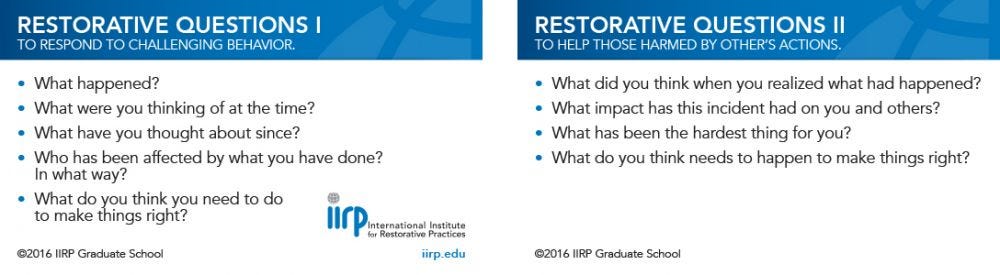
    In a sea of great resources available to educators, I’m grateful to the International Institute for Restorative Practices for these practical conversation prompts. I use them with students often.
    Source: International Institute for Restorative Practices

    Set 1 (on the left) guides my questions with students who have clearly committed offenses against others, the building, or something in the school environment.

    Set 2 (on the right) guides my questions for students who appear to be more on the receiving end.

    Note the last question of each set: What do you think you need to do to make things right? and the slightly different What do you think needs to happen to make things right?

    Those questions are so critical, because they signal our mission. They reveal our community values.

    Contrary to school discipline systems of old, it’s actually not my top priority to mete out swift, precise, and just punishment — as satisfying as that might feel. We’ve learned that formulaic consequence systems — as elaborate, heavy, and consistent as they may be — do not typically lead to lasting character change.

    And they don’t contribute to school culture, either.

    Before I lose you, it’s not that I’m against consequences and disciplinary actions. Sometimes, they’re quite appropriate, and I’ve delivered them many times.

    But when something has been broken, punishment isn’t the top priority. Instead, it’s healing, repair, and restoration.

    What do you think you need to do to make things right?

    What do you think needs to happen to make things right?

    So … should we make students apologize?

    First, let’s take a moment to agree that none of us can really force a student to apologize if they don’t want to. We can’t move their mouths and make words come out. And we certainly can’t apply coercion, stress, or the threat of punishment to elicit apologies that mean anything, anyway.

    So we’re not really talking about “forcing” students to do anything.

    But should apologies be required?

    When I’m confronted with hard policy decisions, I like to return to this tried-and-true filter:

    • Is this best for learning?
    • Is this best for kids?

    These are the two questions that we come back to as educators. They form the filter for just about any K-12 policy decision that you can think of.

    So when I consider conflicts that occur in my elementary school, when I look at cases where students have harmed other students, staff members, or property, I think about the steps that must be taken in order to make wrong things right. To repair what was broken.

    And friends, I just can’t see a world in which harms have been repaired and relationships restored that does not involve apologies.

    It’s true in marriage. It’s true in families. It’s true in business and on our staff teams.

    When problems occur and people are hurt, we name the problem and take steps to address it. That’s Relationships 101.

    Sure, some student apologies will be fake or only half-authentic.

    • But all verbal apologies still require looking at another human being.
    • They still require naming the offense.
    • They still require explaining why the offense was a problem.
    • They still require committing to do better.
    • And they still require asking for forgiveness.

    Colleagues, these are life skills. These are skills that our children will need in order to survive and thrive as partners, parents, and leaders.

    I have no interest in depriving our children of the character-building opportunity that is apologizing.

    So no, as long as I’m in my current role, an apology won’t be a mere option for the next student who punches another. There won’t be any skating by big mistakes as if they never happened.

    There won’t be any you-can-apologize-if-you-want-to choices for kids.

    Obviously, cool-down periods are often appropriate. Where safety is threatened, physical separation can be a higher imperative.

    An apology is not a thing to rush without first re-establishing basic trust and respect.

    But generally speaking, student apologies should be a requirement.

    Because at my school, and at yours, we own our mistakes, and we repair the things we break.

    That is who we are and this is what we do.

    That’s the culture I want.

    And that’s why I’m in favor of forced apologies.
  • I Still Get to Do This

    I Still Get to Do This

    Just about every teacher I know experiences the school year as an emotional cycle.

    We love the work. We love our colleagues. We love our students. We love the creative energy of the profession.

    The art of learning and growing together is fire, as the kids say. It’s pretty magical.

    And then the work starts to gain weight.

    Students misbehave. Colleagues disappoint. Administrators miscommunicate. We mess up. Parents complain. Grading accumulates. Emails bury us. The days got darker. The commutes get longer.

    Then, when our mental-emotional tanks are at seasonal lows, we enter reporting periods. Our workloads multiply and intensify.

    It’s in those seasons that we hardly have time to sleep, let alone cook nutritious meals, fold laundry, or exercise. Loved ones gently ask why we are so absent, so listless, so emotionally guarded and withdrawn.

    Because I’m a teacher, we respond.

    It’s then, in the depths of overwhelm, that we’re washed over by waves of escapism, by dreams of a calmer, more stable 9 to 5 life.

    Sound familiar?

    I get there sometimes

    My education content brand is Teachers on Fire. I think a lot about what it takes to help teachers remain on fire instead of burning out. As a vice-principal who cares for my teachers, sustainability is EVERYTHING.

    Like, we can talk about learning, instruction, access, inclusion, and technology all we want, but if we’re losing good teachers, what’s the point?

    But I too get pulled under by the escapism wave sometimes. Failure, fear, and relentless fatigue combine at certain points in the year to make me dream of other ways of existing in the world.

    A thought experiment: list the things you would miss

    Paradoxically, it’s when I get most serious about moving on from teaching that I get most practical about what I enjoy every day.

    Visualizing an alternative work life loops me back to humility and gratitude.

    This isn’t some lame attempt at let’s-talk-ourselves-into-this. Stay with me here.

    What I’m suggesting you to try is to think clearly, rationally, and honestly about the amazing wins of this work that you will freaking miss once you’re out of schools for good.

    Here are just some of the actual things that I get to do on Monday that I will no longer be able to do if I quit tomorrow.

    • I get to see the light bulb moment.
    • I get to comfort children in despair.
    • I get to make a lot of creative decisions.
    • I get to inspire children and build dreams.
    • I get to play soccer at recess with passionate third graders.
    • I get to goof around and share jokes with middle schoolers.
    • I get to work among people who show genuine care for me.
    • I get to facilitate relationship repair between little humans.
    • I get to learn names and attribute value to growing human beings.
    • I get to laugh with and learn from adults that I admire and respect.
    • I get to create school podcast content that delights my community.
    • I get to do work that leans into my most deeply held beliefs and core values.
    • I get to hear friendly greetings of “Hi, Mr. Cavey!” over 100 times a day, I’m sure.

    At some point, I will be gone from the classroom. And so will you. We all will.

    But not yet. Not today.

    Today, I still freaking get to do this.

    Today, I’m teaching.

  • How to Support Our Students in An Age of Cyberbullying with Eva Harvell

    🔥 What’s the state of cyberbullying in our schools today?

    🔥 What are the silent impacts on our children, and what can we do to protect them?

    🔥 When used effectively, can devices actually increase collaboration and communication in the classroom?

    Join me in conversation with Eva Harvell as we dig into these and other critical questions.

    About This Guest

    Eva Harvell serves as the Director of Technology for the Pascagoula-Gautier School District. She was recognized as the 2021 Mississippi Educational Computing Association’s Administrator of the Year. As a national speaker, published author, doctoral candidate, and an Education and Research Partner for the Mississippi AI Collaborative, she drives innovation in K-12 educational technology.

    Connect with Eva Harvell

    • on LinkedIn and
    • on X @techie_teach.

    This episode is sponsored by Linewize.com. Linewize helps schools, districts and the communities they serve to keep children safe and thriving in their digital lives – in school, at home and everywhere in between. Visit Linewize.com to learn more about their best-in-class filtering, threat detection, and student empowerment solutions.

    In This Conversation

    • 0:31 – Who is Eva Harvell?
    • 1:54 – Story time: moving from the classroom to a new position
    • 4:58 – What is the state of cyberbullying in our schools today?
    • 12:22 – What is Linewize and how does Linewize support schools and districts?
    • 23:46 – Are student phone bans the right path forward for schools?
    • 29:06 – Australia’s attempt to ban social media for minors
    • 31:37 – Can devices in the classroom actually promote the 4 Cs?
    • 34:21 – Eva’s thoughts on AI tools in schools right now
    • 38:19 – Google for Education is squeezing schools and districts into paid tiers
    • 41:09 – A productivity hack: lists
    • 41:42 – An edtech tool pick: Claude.ai
    • 42:05 – Book recommendations: Atomic Habits by James Clear and Essentialism by Greg McKeown
    • 42:38 – Educators to follow: Amanda Bickerstaff on Linkedin and Susan Bearden on X

    Connect with Teachers on Fire and Host Tim Cavey

    Song Track Credit

    • Tropic Fuse by French Fuse
    • GO! by Neffex

    *All songs retrieved from the YouTube Audio Library at https://www.youtube.com/audiolibrary/.

  • Saving Our Teachers: Emotional Wellness for Educators with Erin Tashian and Michelle Papa

    🔥 What can teachers do to protect their fire for teaching?

    🔥 What can we do to attract and keep great people in our profession?

    🔥 What happens in a school community when the principal is not okay?

    Join me in conversation with MICHELLE PAPA and ERIN TASHIAN as we dig into these critical questions.

    About These Guests

    Michelle Papa is the principal of a nationally recognized Middle School to Watch in Northern New Jersey. She is passionate about supporting a healthy and inspiring school climate and culture, understanding this starts with the principal. Michelle is dedicated to continuing her personal and professional growth around the social and emotional learning competencies and is hoping to inspire other educational leaders to do the same. She’s had the privilege to partner with Erin Tashian to promote this mission within her school and district and has seen tremendous impact on her students, staff, and community as a result.

    Erin Tashian is a distinguished educator, coach, and professional developer, renowned for her efforts in supporting the educator wellness through emotional resilience and self-awareness practices. Erin believes that it is our responsibility as educators to develop a deep understanding of our emotional world so we can create safe, connected school communities that support students and staff academically and emotionally.

    Connect with Michelle

    • on LinkedIn and 
    • on X @MPapaEdu.

    You can connect with Erin

    Tune in for my regular Teachers on Fire interviews, airing LIVE on YouTube every Saturday morning at 8:00am Pacific and 11:00am Eastern! Join the conversation and add your comments to the broadcast.

    In This Conversation

    • 0:32 – Who is Michelle Papa?
    • 1:09 – Who is Erin Tashian?
    • 2:30 – Why Erin Tashian left 31 years of teaching elementary to support teachers
    • 5:08 – Is it okay when the principal is not okay?
    • 8:42 – Challenges that teachers face today
    • 11:37 – Michelle on her takeaways from Erin’s work
    • 14:08 – Erin Tashian’s Educator Wellness Institute
    • 19:09 – Sustainability strategies for new teachers
    • 24:03 – Are we pressuring teachers right out of the profession?
    • 32:16 – The mission of The Mindful Educators Podcast
    • 34:37 – A personal habit or daily productivity hack
    • 36:02 – A favorite edtech tool or app
    • 37:49 – Book recommendations
    • 39:55 – Inspiring educators worth following
    • 41:45 – Where to connect with Erin Tashian and Michelle Papa online

    Connect with Teachers on Fire and Host Tim Cavey

    Song Track Credit

    • Tropic Fuse by French Fuse
    • GO! by Neffex

    *All songs retrieved from the YouTube Audio Library at https://www.youtube.com/audiolibrary/.

  • How to Install the FREE Brisk Teaching Chrome Extension

    OH. MY. GOODNESS.

    I mean, I kind of knew this was possible.

    But now I KNOW. And it’s FREE.

    Access smart, grade-relevant feedback on student writing instantly with the Brisk Teaching Chrome extension (link to webstore).

    I honestly believe that tools like this one have the potential to help save teachers from burning out and leaving our profession.

    Watch my tutorial to get started!

    *not sponsored