

What if your health was actually the single biggest factor in job satisfaction?
A new school year is under way, and I have two questions for you, colleague.
How are you finding the work so far?
Are you finding joy in the labor?
Here’s something I’ve been thinking about lately: the state of our health plays a much larger role in our job satisfaction than we would like to admit.
Think about it. When you’re in fantastic health, your capacity is high, you’re more resilient, you’re emotionally generous, you can be curious and inventive and adventurous.
You’re self-actualizing as an educator. It’s vocational bliss.
On the other hand, when your health is poor, your capacity is low, and you’re emotionally fragile. You cling to what’s safe and easy, you’re less effective in the classroom, and problems make you more furious than curious.
We all know on a sort of intellectual level that all of that is true. It’s a reality of most kinds of work, but (I believe) especially true in the demanding context of K-12 education.
Then we go ahead and punish our bodies, wonder why we’re depressed, and dream of quitting K-12 education for something easier.
I don’t know how old you are, colleague, but I’m 46. For me to be effective around the 600 students and 75 colleagues in my elementary school, for me to find joy in the work on a daily basis, I have to be in the best health possible.
My job performance, satisfaction, emotional health, and people around me depend on it.
So I’m taking action with six daily habits that fight fatigue, reduce stress, improve sleep.
1. Drink a liter of water to start every morning.
I’m eleven months into a new condo, and it’s funny — one of the highlights of the new place is the automatic ice maker in the freezer. Yes, these have been around for decades, but I’ve never lived in a home with one.
Thanks to the infinite ice cubes at my disposal, I’m now in a routine of filling two large thermoses with ice water each morning, and that’s my fuel for the 30-minute commute into Vancouver. It’s refreshing, hydrating, and sets up my body for success.
For many years, I was a Starbucks drive-through kind of commuter. I still love the coffee, but I now wait until I’m in my office.
Water first.
2. Stop eating by 7pm on school nights.
Friends, I’ve become a fasting believer. Perhaps you’ve heard about fasting for years and have never given it a shot.
It took a long time and a lot of listening for me to even become open to the concept. And I’m still not the most religious fasting person out there.
But I can tell you that this one rule — cutting off eating and sugary beverages by 7:00 pm — produces incredible results.
Seriously. Incredible.
First, in terms of weight gain, I’m not packing on the extra pounds that come when I slam my body with calories immediately before sleep.
More to the point, my eating curfew produces results that I can feel. I wake up feeling lighter, more energetic, more ready for the day. My body enjoys deeper sleep since it’s not having to work on digestion.
If you’re used to snacking in the evenings, just try this rule for a week. Tell me you don’t feel noticeably better when you wake up.
3. Be in bed by 10pm on school nights.
Since my school day wake-up alarm is set for 5:00 a.m., my in-bed-by-10 rule isn’t actually the ideal target. Nine o’clock would be better, and maybe I’ll hit that mark once in a while.
But I’m trying to be a realist here, folks. Goals have to be consistently achievable, right?
So I’m aiming to be physically in bed for >7 hours each night. And to get there on school nights, the computer needs to close by 9:00 p.m.
Unless I’m facing a significant deadline or project that absolutely must be completed that evening, that’s got to be it.
The bedtime routine begins at nine.
4. Exercise daily.
I find streaks motivating.
On April 1st of this year, I completed one push-up. On the 2nd, I completed 2. On the third, I completed 3.
I was on vacation in July when I hit 100. By late August I was at 150, and I still hadn’t missed a single day. By that time, it was taking several sets and about 25 minutes to complete my daily quota.
I had to let that streak go, but I started a new one on September 1st. I’m back in the saddle, making sure that as a daily minimum, push-ups are happening.
On school days, I’m also doing chin-ups, bench presses, and dumbbell curls before work. Less than 20 minutes in the gym, but enough time to raise my heart rate and keep my fitness in a decent place.
My push-up streaks ensure I don’t go a day without at least a little strain on the ‘ol muscles.
It’s a consistency that I know I can maintain for months at a time.
5. Run 25 kilometers (15.5 miles) per week.
Regular running is another important piece of my health.
It helps me burn stress, strengthens my heart and lungs, and fills me with happy hormones.
For a 46-year-old battling high blood pressure, and with a history of bad heart health in the family, it’s literally essential.
I started this year aiming to run 1,000 km. That’s an average of 19 km/week or 2.7 km/day. Eleven other awesome educators joined me for this challenge on Strava, and some have already completed their thousand.
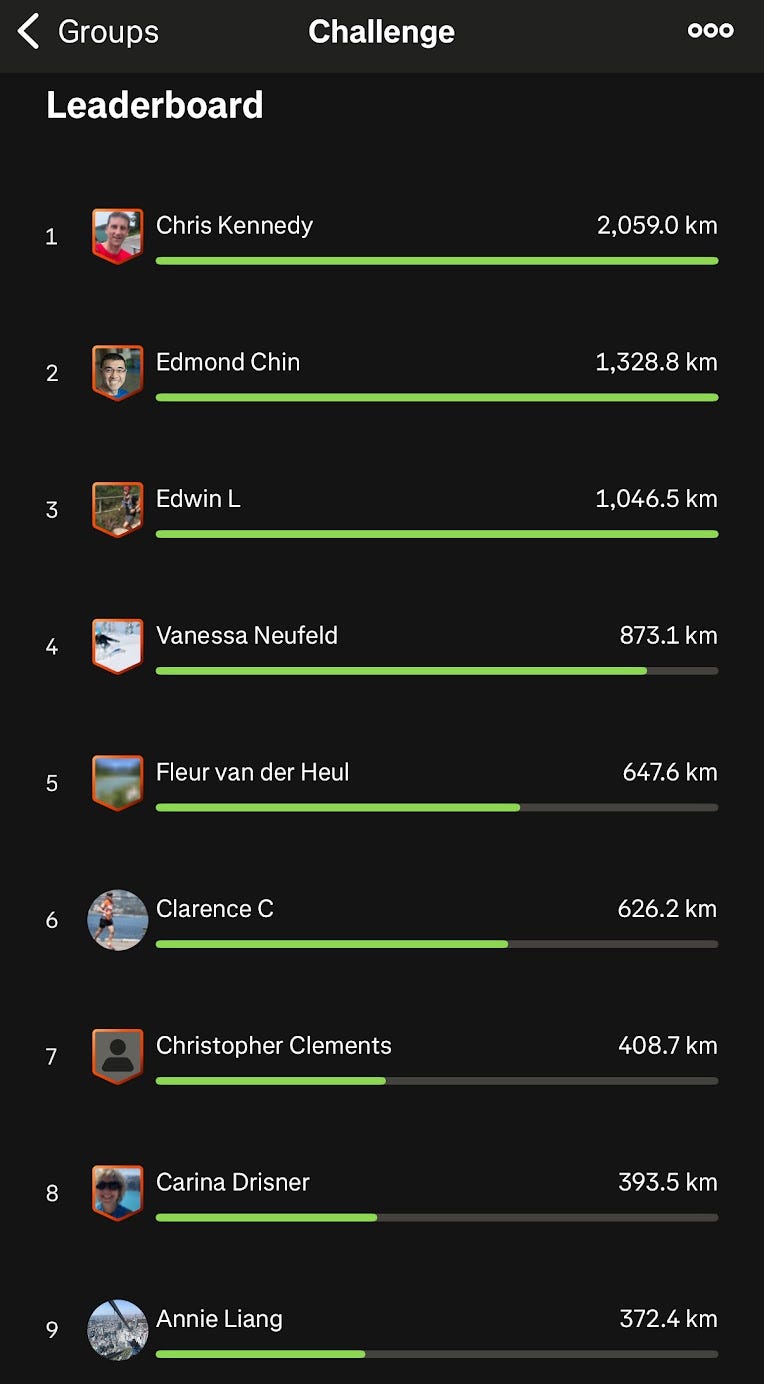
With 322 kilometers completed by early September, I’m probably not going to reach my goal for 2025. But my year-end total will almost certainly be a personal best.
Sometimes I run before school, sometimes when I get home. Often, I’ll do a longer run on the weekends.
But I know from experience that a habit of >25 km/week is doable and sustainable. And I know my running friends on Strava will support me every step of the way.
6. Walk and sleep with my partner daily.
My wife and I both work full-time. Our schedules vary, we come home at different times, and as a result, our dinners during the week are inconsistent.
To compensate for the chaos and to make sure we stay emotionally connected, we insist on two things: walking together almost daily and going to bed together every night.
These can be hard sacrifices to make, especially when the inbox is full and the task list is long. But that 30-minute walk and talk will do more for my emotional and mental health than 50 read emails can dream of doing.
As long as we’re hitting these two habits consistently, it means we’re communicating, we’re nurturing our relationship, and we’re supporting each other through the stresses that come.
That support is a wonderful blessing of a good (not perfect) marriage, and when I think about my mental-emotional health in the workplace, it’s a significant factor.
Final thoughts
I know from experience that I’ll feel absolutely great if I can hit all of these goals consistently — mentally satisfied by the victories, yes, but also just physically great.
That’s not to say I don’t have room to improve. I still eat too much processed food, for example. I need more greens and fiber in my diet. As I mentioned earlier, I’d be in better health if I slept for eight hours a day.
But this is where I’m at right now: six goals that I know from experience are doable.
Six habits that make a practical, visceral difference in how I show up at school each day. Habits that raise my capacity, resilience, emotional generosity, curiosity, and ambition.
Are they always easy? No. But the people around me make them worth it.
I’ll keep you posted.

 Teachers on Fire
Leave a comment