• Two Scary Phone Habits That Will Bring Back Your Fire for Teaching

    You’re not a victim: empower yourself by controlling your phone.

    You’re lying in bed, minutes away from going to sleep. You’re looking sleepily at your phone and notice a new email. It’s from a parent of one of your students, and the subject line sounds emotional.

    Uh-oh.

    Your blood pressure skyrockets as you scan the opening lines. You put the phone down beside your bed, but it’s too late. You’re already rehearsing responses and worrying about how much time and energy this issue will steal from you the next day.

    Bye bye, sleep.

    On another evening, you’re trying to focus on a complex task and your phone starts buzzing repeatedly. Who’s messaging me like a madman right now?

    You try to recenter your focus on the project, but you can’t shake the question. After a minute or two, you pick up your phone. I’ll just see who it was.

    Fatal mistake. The teacher chat is popping off with questions about a school event happening the next day, and someone’s asking for support. As one of the more experienced members of the team, you’re one of the few who can answer questions and share resources. You jump in, and now you’re living in the chat for the next 30 minutes.

    The conventional wisdom says you’re a victim.

    These are well-known problems in teacher land, and the fingers often get pointed angrily at the origins of the messaging.

    Why do they need to send me an email so late in the evening?

    How dare they message me on my weekend?

    Why won’t they respect my time?

    First: the practical problems with scheduled emails

    One well-traveled admonishment that I’ve heard in the last few years is for teachers and administrators to schedule all emails. Never send in real time on an evening or on a weekend — always schedule it for the next school day morning, this thinking goes.

    I tried to hold to that religiously for a while. But I’ve noticed some practical problems with the practice.

    For one, scheduled emails can waste everyone’s time.

    Let’s say that a teacher emails three colleagues for a solution to a problem they’re facing. It’s entirely possible for all three recipients to craft lengthy, thoughtful replies to the query and schedule them all for Monday morning.

    When the three replies arrive, it turns out there’s a whole lot of overlap and redundancy between them — they’re all saying the same thing. It’s a maddening waste.

    Scheduled emails can also create confusion.

    Scheduled emails can lead to email threads with conflicting or old-news replies jumbled together out of chronological order.

    The thoughtful reply that was crafted on Saturday morning has been made utterly irrelevant by a decision made on Sunday night.

    Worst of all, scheduled emails can create more stress than ever.

    Just put yourself in the shoes of any teacher who comes into school on a busy Monday with no scheduled prep blocks to be greeted by an avalanche of unread emails written since Friday at 3:30. I’m not convinced that’s such a blessing for teacher mental health.

    Feeling some doubts around the scheduled email practice, I went to teachers to get a sense of their preference. I posted a poll on Twitter and 189 responded.
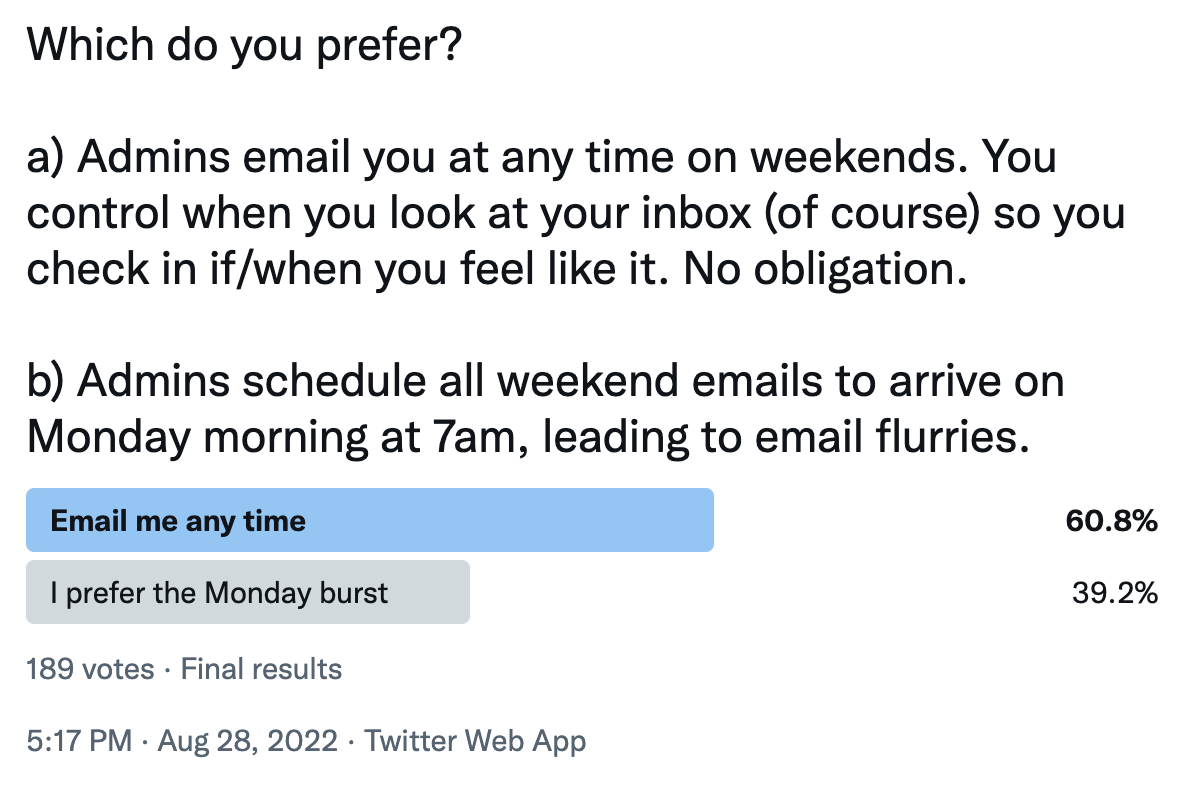
    As I suspected, the majority of teachers would actually prefer the option (not mandate) of reading school-related communications on the weekend (if and when they want to) versus the Monday morning avalanche.

    Two radical phone habits that will bring back your fire for teaching

    If scheduled emails aren’t the answer, we’re still left with the phone anxiety I described at the top. How can we keep digital communication in its place and make sure that we are engaging on our terms and not someone else’s?

    As Dave Ramsey likes to say, you have to be sick and tired of being sick and tired in order to make real and painful changes.

    Perhaps you’re there with phone emails and notifications.

    Wherever you are and whatever your lived experience, here are two radical moves that will transform your lived experience.

    Buckle up.

    Habit 1: Leave your phone out of the bedroom at night

    What if I told you that there was one simple change that you could make to your life that would produce the following:

    • Less stress about work
    • Less blue light in your day
    • Less electronic activity near your body
    • More sex
    • More sleep
    • More reading
    • More pillow talk
    • More journaling and reflection

    That’s right. Leaving your phone out of the bedroom at night will produce all of these benefits and more. Guaranteed.

    I started this practice a few years ago and find it easily one of the most personally transformative changes that I’ve ever made. It’s one of those simple-but-hard moves that absolutely anyone can make that costs nothing.

    Even beyond the bullet list of benefits above, there’s a quality of mind that’s hard to describe and impossible to quantify when your phone is not on the same floor as you. It’s like going off the grid, but better.

    And you can do it. Of course, I’ve heard all the reasons why people can’t make a similar move to keep their phones away from their bedroom at night.

    • “I need my phone for an alarm clock.”
    • “I need to be available for my children.”
    • “I need to be available in case of emergencies at the school.”

    Most of this amounts to “What if” and FOMO.

    Relax.

    You’ll be okay without your black mirror beside your head while you sleep, just like your parents were.

    Scary habit 2: Keeping your phone permanently on Do Not Disturb

    As Tristan Harris points out in The Social Dilemma, things that are actually tools don’t control us. They don’t call to us. They don’t insist on breaking our focus.

    Tools do exactly what we want them to, when we want them to. They are humble servants.

    It’s for that reason that I don’t want to hear from my phone. At all.

    Turning my phone’s ringer off is a no-brainer place to start, but that isn’t enough for me.

    I don’t want vibrations when my phone is sitting on a surface. I don’t want my phone waking up (lighting up) with notifications of any kind. Ever.

    If I’m occupied with a task, I want radio silence and a screen that stays dark.

    And that’s what I get. By leaving my phone on Do Not Disturb (look for the moon symbol) 24/7, my phone never lights up, vibrates, or rings.

    My phone tells me that I’m receiving an average of 168 notifications per day, and the apps pictured below the graph show the number of notifications each one would generate on a weekly basis if I allowed them to.
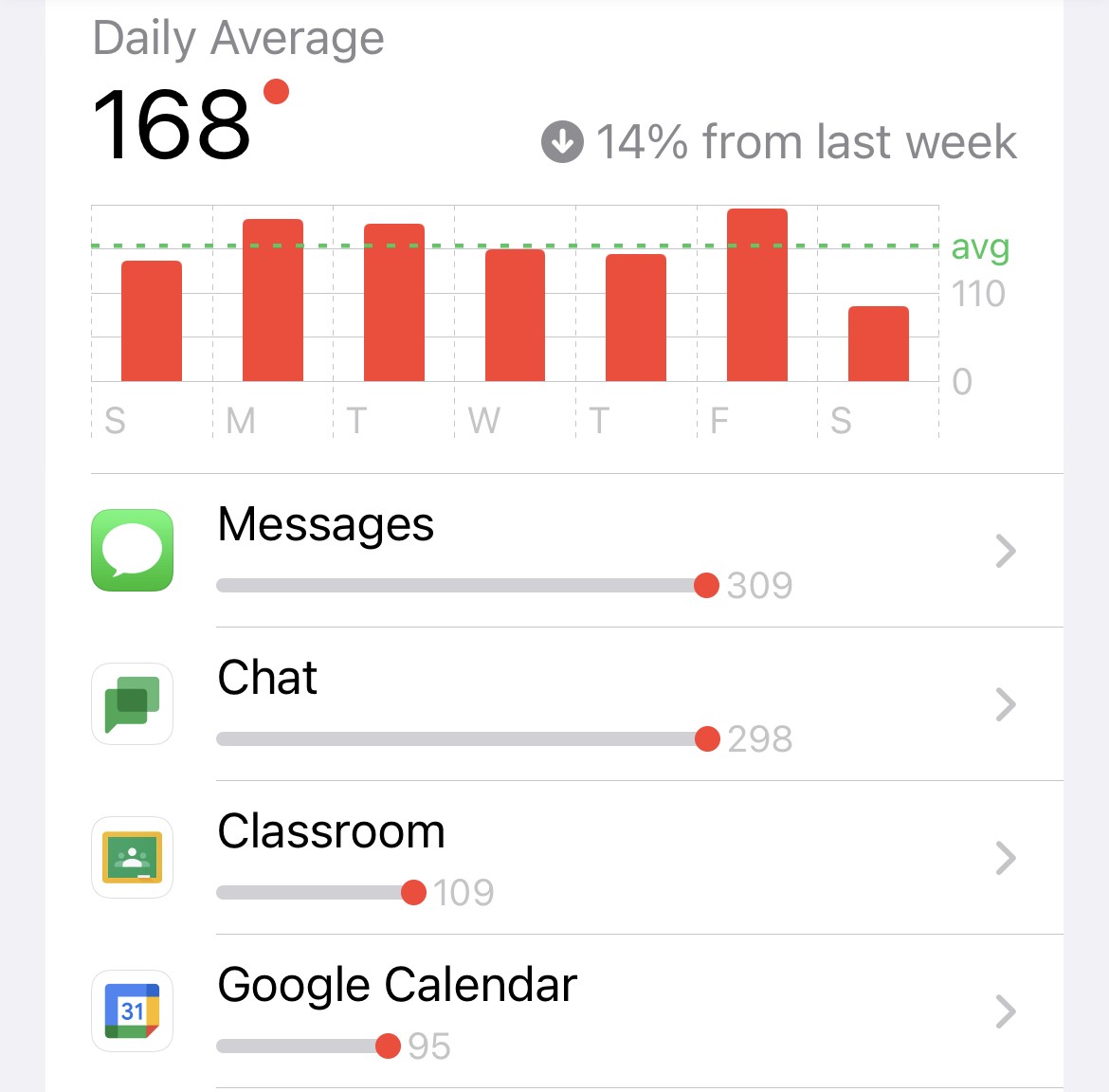
    Some of the 168 notifications per day that I’m not receiving on my phone thanks to DND

    The iPhone exception: favorite contacts can reach me

    I can’t speak to Androids, but iPhones allow a small loophole for the conditions I described above.

    If I’ve tagged a contact as a Favorite, their calls and messages will come through. That means that my wife, kids, parents, and school administrators can still call and text me. As a husband, parent, and vice-principal, I’m realistic enough to acknowledge that some exceptions must be made.

    For the rest of the world, including my colleagues, they are still free to message me on iMessage, Google Chat, WhatsApp, or whatever. I purposely leave badges on those apps, so the next time that I open my phone, I’ll see that I received a message.

    But I’m coming to the message on my terms, when I want to. I’m not allowing others to barge in on my work whenever they please.

    Why not just remove all school email and apps from your phone?

    This discussion wouldn’t be complete without addressing the Scorched Earth method. I know at least one colleague who refuses to have school-related communication (email or Google Chat) on his phone. And I know there are others who believe in that level of compartmentalization.

    I respect the intention there, but I’m not interested. To me, the ability to be able to read and respond to emails and DMs from my team when it’s convenient for me is far too valuable.

    My logic is that if I can read, file, and respond to 30 emails while I’m standing in the Costco line-up or waiting for a family member in the car, that’s 15 minutes of relaxation time that I can spend with my wife instead of sitting down at the computer.

    Or let me put it this way: if I remove all school email and apps from my phone, I’m giving up those micro-opportunities to fend off Email Mountain that a typical day provides. Instead, I’m choosing to either stay longer at the school or give up more of my home time for work.

    Do you like those choices? Neither do I.

    Instead, I keep all options open so that I can respond to them on my terms: when I want to, when I have the emotional energy, and when it’s convenient for me.

    Boundaries create freedom and empowerment

    I titled this piece Two Scary Phone Habits because that’s what they are: scary. Most readers will acknowledge some level of logic in my arguments but will likely ignore both suggestions.

    And that’s okay. It’s not my intention to should on you.

    But if I hear you complain about school messages and emails coming to you at all hours of night and weekend, I’m going to remind you of something: you’re not a victim of some angry parent or over-zealous administrator.

    Take control of your phone.

    Take back your sanity by giving these two phone habits a chance.

    The results just may change your life.

    Photo credit: Flo Maderebner on Pexels.com

  • A Message to Middle Schoolers: Stop Sweating the School Stuff

    Chill is a skill: don’t let academic anxiety steal the joy from your life.

    I’m a vice-principal in a small middle school of 220 students.

    Our kids are awesome. And our families are invested and supportive.

    It’s cool to learn in our school. It’s cool to be a tryhard. It’s cool to help others learn, too.

    Something else. Our assessment system features no percentages or letter-grades.

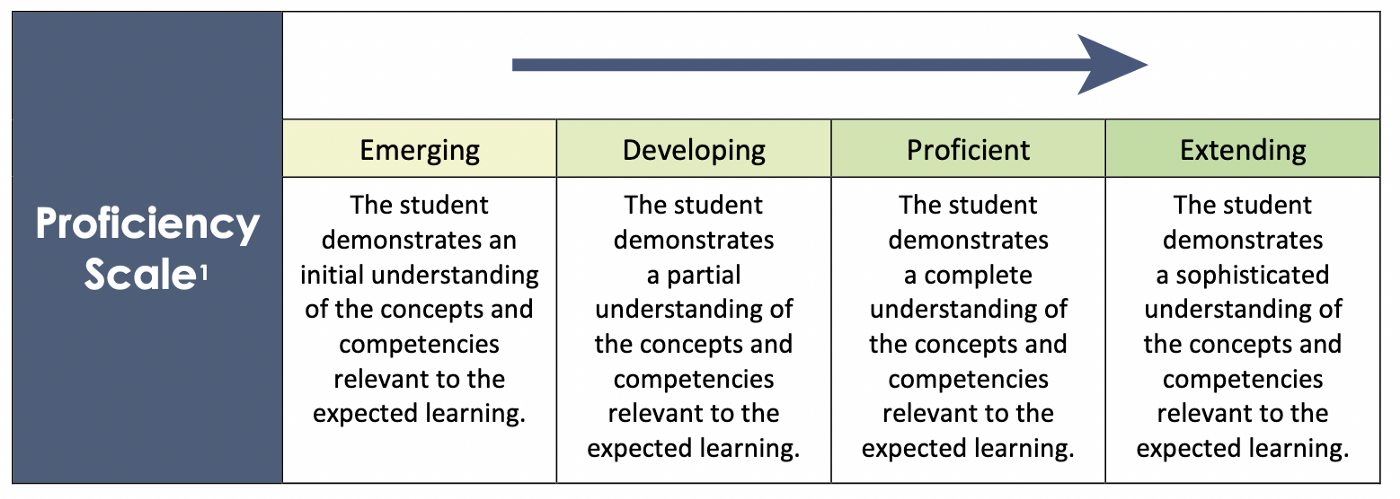
    Instead, evidence of student learning is assessed against curricular standards using a 4-point proficiency scale like the one below.

    By removing letter-grades and percentages from the picture, we’re also getting rid of rank-and-sort. We’re saying goodbye to trophy culture. We’re not interested in defining winners and losers.

    Instead, we’re saying that we are a learning community. We pursue proficiency together because we are all developing learners.

    That’s our messaging, anyway.

    Academic anxiety can persist even in standards-based grading environments

    I know a couple of middle schoolers who regularly demonstrate high proficiency against learning standards in virtually every subject.

    They are committed and determined learners. They’re outstanding collaborators. They’re compassionate supporters and encouragers of classmates. They’re leaders in the room and absolute joys to teach.

    These students project a lot of sunshine and roses, but a silent battle rages below the surface.

    They struggle with intense anxiety around their academic achievement.

    It’s so saddening, and it defies understanding.

    What’s at the root of this anxiety?

    Here’s a bold proposition: no middle schooler should have to deal with academic anxiety. Absolutely none — I don’t care how well their learning is progressing.

    When high school juniors and seniors experience academic anxiety, I don’t like it, and I can make some strong cases against it. For one, the quality of your life will not depend on which college you’re admitted to.

    But with college around the corner, I can at least understand it.

    In middle school — especially one without letter-grades or percentages — it’s almost inexplicable. How can our students possibly lose sleep over their academic performance?

    My theories about where most of this anxiety comes from

    The top-notch counselling team at my school could likely offer more insights, but my conversations with middle schoolers over the years lead me to the following theories:

    1. Parent pressures.

    Well-intentioned or not, it’s no secret that some parents push their children pretty hard. Report card pressure can be intense. One of the many messages: your future depends on shining achievement in school. Threats and rewards of various kinds may accompany these messages.

    2. College admission.

    Linked to parent pressures, this is the idea that success in one’s profession (and in life) depends on admission to the right college or university. We hear this idea from students as early as fourth grade.

    College admission depends on the 12th grade transcript, which depends on stellar high school achievement, which depends on acceptance to honors programs, which depends on strong middle school performance. Ta-da! The roadmap is drawn for a decade of anxiety.

    3. A fixed mindset.

    Some students have been called “smart” so many times in their lives that it becomes a part of their identity. Instead of instilling invincible confidence, hearing a lifetime of “you’re so smart” can create a fear of slipping or risking the source of that sacred status. Carol Dweck lays this out beautifully in Mindset.

    Others describe this student as one on defense (stick to what is safe and I’ve proven I can do well) versus offense (try new things, take new risks, engage with difficult tasks when possible).

    Other theories from my professional learning network

    When I reached out to my Twitter PLN for their theories about where this academic anxiety comes from, their answers were insightful.

    4. Personality and Psychological Profile.

    Middle school teacher Riley Dueck observes that “Some students are more inclined to perfectionism/anxiety than others (see Enneagram Type 1 & Type 6).”

    Intermediate educator Maria Dawson puts some of the blame on “Undiagnosed ADD. Builds anxiety and creates internal pressures. Considerably worse in females as the SNAP assessments are all geared for previous typical ADHD behaviours. Sometimes the H can be hyperfocus not hyperactive.”

    5. Peers.

    Erik Murray says “I see it a lot and it comes from peers. It’s like keeping up with the mini Joneses: ‘I got ranked this in the math team — what did you get?’ That sort of thing.”

    Maureen Wicken is on the same page, writing “Comparison: not only is it the thief of joy, but it also destroys our sense of accomplishment, hope, and purpose. And giving everyone participation trophies doesn’t seem to have helped.”

    6. Perfectionism, Procrastination, and Paralysis.

    My incredible colleague Anika Brandt points out more Ps that factor into this conversation: the cycle of perfectionism, procrastination, and paralysis.

    She’s right, of course — some academic anxiety is self-induced (or at least amplified) by destructive tendencies. When this cycle shows up for students, it makes me want to ask: what fears lie behind it, and how can we unpack them?

    We need to be more curious about academic anxiety

    It’s at about this point that some of my education colleagues will pointedly remind me: “Why aren’t you asking the students where their anxiety comes from?”

    I am, and I will. We talk a lot about social-emotional health with our students, but we need to be more direct and more curious about the extent of academic anxiety specifically and its origins.

    When we know more, we can do more.

    In the meantime, I want to share a message specifically to the people that matter most.

    My message to middle schoolers

    Dear students,

    Your teachers and I love you so much. It is an incredible joy to be able to teach and work and learn beside you each day. YOU make the difficult work of teaching all worth it.

    We know that the adults in your life sometimes forget how anxious you actually feel about school. We want to do a better job of supporting you.

    Please let us know when you’re feeling low. Let us know when you’re worried. Let us know when you’re having trouble sleeping or eating because the school anxiety is so intense.

    Your teachers want to help, and sometimes we can support you in ways that you didn’t expect or may not have thought of.

    Oh, and our counselling team is awesome. Being able to talk about your worries with another person can make all the difference. We’d love to set up an appointment for you if you’d be open to that.

    Finally, here’s some honest perspective.

    Middle school life is difficult and complicated enough without worrying about grades and academic achievement.

    You know that as teachers, we’re going to continue to encourage you to be curious, be daring and adventurous with your learning, apply yourself, use class time well, and collaborate with others.

    But trust us when we say this: no matter how your work is assessed, you’re going to be fine. Really. The quality of your incredible future doesn’t depend on your middle school grades.

    So keep developing yourself. Keep following your passions and curiosities. Keep having fun, enjoying good laughs, and building solid friendships.

    That’s what middle school life should be about. Please don’t allow your academic achievements to steal that from you.

    Stop sweating the school stuff, and enjoy every day of this crazy thing we call life.

    We’ll be cheering you on every step of the way.

    Mr. Cavey

    Quick Tutorial: How to Remove Video Background in Canva

  • Should Teachers Attend Student Performances Outside of School?

    “Why didn’t you attend our daughter’s musical?” the parents asked.

    Photo Credit: Kristijan Arsov on Unsplash.com

    Teaching is an amazing and rewarding space to work in.

    It can also be utterly exhausting. As Washington teacher Tyler Rablin reminded us, it’s emotionally, mentally, and physically demanding work.

    In the third term of last year, I was asked to attend three different performances involving my students. These were personal events completely unrelated to school. They included gymnastics, a choir performance, and a musical. They were scheduled on evenings and weekends.

    I declined all of them.

    You know these students mean well. In fact, it’s touching — humbling, even — that they wanted me there at those events, in the seats, cheering them on and bearing witness to the product of their dedicated preparation.

    So I don’t blame them or their parents for wanting me there.

    But as a part-time vice-principal, I get a little feisty when teacher wellness is put at risk unnecessarily. School-sanctioned evening events are already a big ask and take a big toll on teachers: I’m thinking here of Meet the Teacher Night, parent conferences, band concerts, and the like.

    Keep in mind that many teachers are also parents, meaning they’re pulling double or triple duty for these evening events.

    One night they’re supervising a band concert at their own school, the next night they’re wearing their parent hat and attending their child’s concert at another school. One night they’re hosting parent conferences, the next night they’re attending them.

    Been there.

    This on top of all the other countless demands that teachers must stay on top of outside of class time: lesson planning, feedback, IEP communication, email, and endless administrivia.

    The parent and partner guilt that most teachers live under

    Speaking of family life, many teachers operate under a continuous cloud of guilt. They may not admit it on the surface, but talk to them for any length of time and you’ll get a sense of what I’m talking about.

    They wish they could be more emotionally available for their partners.

    They wish they could have more energy for their own children.

    They wish they could have more time to cultivate real relationships outside of work.

    Now take the weight of this guilt and imagine them sitting through a 2-hour musical on a Wednesday night. It’s not good.

    They’re tired. Their partner or children are at home. Lessons are waiting to be planned. Assignments are waiting for feedback.

    It would be a touching gesture on the part of a generous teacher to show such support, but in my mind it just doesn’t add up.

    The problem of precedent that parents must keep in mind

    There’s another important reason why teachers are wise to decline these kinds of out-of-school student performances, and well-meaning parents may not recognize it at first.

    If Miss Robinson says yes and attends Jackie’s figure skating championship, that only raises the pressure on her to also attend Jenny’s violin recital, Eddie’s swim meet, and Twila’s musical.

    Even worse, it raises the pressure on her colleagues to do the same. It becomes a lot harder for teachers to decline all student performances when a colleague is somehow out in the community attending one of these performances after another.

    Why didn’t you attend our daughter’s performance?

    Last year I sat (in my role as part-time vice-principal) with a teacher while her parents asked her point blank: “Can we just ask why you didn’t attend our daughter’s performance?”

    The implication was clear. You should have been there.

    I didn’t like the question at all, but I was silent and allowed my colleague to respond.

    It was a difficult moment. In my 22 years as an educator, I don’t think I’ve ever heard that question before.

    If put in that situation again, I’d like to jump in. “Because we encourage our teachers and colleagues to say no to student performances happening outside of school,” I’d say flatly.

    Teacher health and wellness requires a recognition that our time and energy are limited. Limitations require careful budgeting, and budgeting requires discrimination based on priorities.

    None of us are wealthy enough to distribute money indiscriminately. That’s just common sense.

    The same goes for time and energy. These are finite resources. And in the teacher life, they’re incredibly valuable.

    Photo by Daniel Thomas on Unsplash

    In defense of teachers: parents, please don’t ask this of them

    Parents, we love you dearly. It is such an honor and a privilege — truly, it is an incredible joy — to serve your beautiful children each day.

    Help us be our best selves.

    Help us keep the joy in our work and the fire in our eyes.

    Help us protect the emotional bandwidth we need for the dozens of little people we interact with each day.

    When it comes to your child’s performances, you’re welcome to send teachers a YouTube link to their wonderful work. If we have time, we just may watch a minute or two and leave a comment.

    But please don’t ask a teacher to attend your child’s performance in person.

  • What is assessment?

    When it comes to K-12 education, it’s pretty much everything.

    Photo Source: Barrett Ward on Unsplash.com

    The closer you look at assessment philosophies and practices, the more you realize that assessment shapes instruction, learning, language, calendars, culture, and virtually every aspect of life in K-12 schools.

    Assessment is everything.

    For decades, schools and educators clung to old paradigms of assessment.

    They treated grades as wages: students do the work, and teachers pay them for that work.

    They treated assessment as a means of ranking and sorting: winners at the top, losers at the bottom.

    They treated assessments as leverage to ensure compliance: follow the rules, and you’ll be rewarded. Color outside the lines or show up late to class, and we’ll use grades to punish you.

    These old systems of assessment inspired courage and fear. They dealt honor and shame. But they often had little to do with the learning itself.

    No more. Assessment in our K-12 schools is turning a corner. And the future is bright.

    “Write, in one sentence, your definition of assessment.”

    That was the request I put out to my professional learning network on Twitter this fall. I thought that if a few of my colleagues engaged with this question, some rich dialogue was sure to follow.

    And engage they did. Thank you, PLN.

    What a rich conversation. Every tweet you’re about to read gives me pause.

    This thread is so rich that I had to memorialize it. Enjoy, and may this thread spark further thought on your own journey of assessment.

    What IS assessment?

    And implied: What is the purpose of assessment?

    1. “A tool to evaluate and improve learning.” — Audrey McGregor @AudreyMcGregor1
    2. “Assessment is doing whatever I need to do with you in order to get inside of your head to understand what you need to know, understand, and do to take your next step on your learning journey.” — BeckyFisher73 @BeckyFisher73
    3. “Assessment = checking in.” — Conklin Educational Perspectives @ConkEdPerspect
    4. “Show me what you got!” — Nick Covington @CovingtonEDU
    5. “Identifying where students are in skill and understanding, and offering suggestions for their next steps of learning and refinement.” — Craig Voskamp @CraigVoskamp
    6. “A dialogue to learn about your learning.” — Chris Smith @cssmithteach
    7. “Assessment is any informed process engaged by teachers and/or learners that illuminates where a learner is at in the learning process, how they got there, the learner’s and teacher’s next steps, and how to get learners to their goals.” — Shannon Schinkel @DramaQueenBRC
    8. “Assessment is the ongoing process of gathering, analyzing, and interpreting evidence (State Government of Victoria, Australia © 2019).” — Dr. David Gentile @drdgentile
    9. “Assessment is any means by which we gauge our own or someone else’s current understanding of a selected subject.” — J. Nicholas Philmon @DrNikPhilmon
    10. “A snapshot in time measurement of student understanding and ability to demonstrate mastery of taught curriculum.” — ProwlMom34 @DRoss625
    11. “Checking in with the learner to see if what they’re understanding about a subject is what you’re trying to teach.” — Eileen McDaniel @EileenM02086562
    12. “Three types of assessments are critical to good teaching and should be helpful to both the teacher and the learner — diagnostic, formative, and summative.” — Elliott Seif @elliottseif
    13. “When learning to ride a bike, three questions show three critical assessments: Can the learner get on the bike? (diagnostic); What feedback will help the rider as she learns? (formative); Can the rider ride on his own? (summative). From Teaching for Lifelong Learning, chapter 3.” — Elliott Seif @elliottseif 
    14. “One way I figure out what to do next.” — Erin Earnshaw @erin_earnshaw
    15. “Helping students find their next steps.” — James Abela @eslweb
    16. “Assessment is the act and process of seeing or noticing the relationship between the learning target and the actual learning. It allows a knowing with which to make sound decisions about what happens next.” — Andrew Maxey @ezigbo_
    17. “Assessment is reflection’s GPS.” — Heidi Graci @formermingo
    18. “Where do I start my teaching from?” — Francis Joseph @Francis_Joseph
    19. “There are practice days and there are game days.” — Glenn Morgan @glennirvinem
    20. “Assessment: (noun) A tool or process that provides data on progress (or lack thereof) towards a goal.” — Monica Agudelo @good_elo
    21. “Assessment captures a snapshot of what a student could demonstrate in that moment. A collection of assessments taken over time provides a more accurate picture of how a child is growing in their learning.” — Kimberly Church @HolaMrsChurch
    22. “Assessment is the provision of explicit feedback on any artifact of learning with the goal of furthering that learning.” — Jeff Hopkins @hopkinsjeff
    23. “A way to see if they know what I need them to know.” — Toby Price @jedipadmaster
    24. “Measurement of student growth to provide feedback and generate more growth.” — Jen Smielewski @JenSmielewski
    25. “The collection of evidence of student achievement on desired learning outcomes.” — Josh Kunnath @JoshKunnath
    26. “Determination of current state in relation to future state and the responses we take to move toward goals. Assessment informs response.” — Katie White @KatieWhite426
    27. “Assessment discerns ‘the known’ and the ‘what next’ for individuals.” — Charlotte P @lifeoflottie
    28. “To assess: to seek information (via conversations, observations or students’ work) in order to learn more about our students (e.g., attitude, understanding, thinking processes, knowledge, habits of mind) for the purposes of improving student learning. While related to evaluation (the process of assigning a value/grade/percentage), assessment and evaluation are very different processes with different goals and outcomes.” — Mark Chubb @MarkChubb3 [two tweets]
    29. “A moment of reflection and celebration on a learning journey where (with another learner) you look back to appreciate how far you came, think about where you now stand, and plan for your next steps in your learning travels.” — Mark Sonnemann @MarkSonnemann
    30. “A method to determine current knowledge/skills to assist in the determination of the next steps for growth.” — Mike Szczepanik @MikeSzczepanik
    31. “One moment in time for a student and teacher, not the end all of anything.” — Mindy Swanson @mindykswanson
    32. “Assessment is showing what you know, receiving feedback on that (from someone else like a peer or teacher, or from deep independent reflection), applying the feedback, and showing what you know again — so it is a continual process.” — Brenda Ball @misssball
    33. “Assessment is one measure of the effectiveness of instruction.” — Michael Bissell @mrbissell
    34. “To sit beside. It’s a visible image of learning. Collaboration, relationships, growing, mutual feedback, responses, respect, and HOPE!” — Jim Smith @MrDataGuy
    35. “Show me what you know.” — Adrian Neibauer @MrNeibauer
    36. “How you know they know.” — Rebekah Shaw @MrsShaw_TCC
    37. “The tool to see individual progress and point out the next steps.” — Nathalie Magel @nathalie_magel
    38. “Informal or informal way to check learner progression. Specific feedback for growth must be given by the teacher.” — Misty Kirby @OneLove_mk
    39. “How both teachers and learners know learning is happening and why and how it’s happening.” — Pam Moran @pammoran
    40. “Informing strengths and next steps in learning.” — Ms. Pope @PopeSD36
    41. “To collect the necessary information to understand a learner’s instructional needs.” — Practice Readers Books @PracticeReaders
    42. “What the heck did my students learn and how do I know they learned it?” — Daniel Katz @Prof_Katz
    43. “Assessments are educational health checks, so we know what to prescribe to each individual.” — Lozetta Hayden @Quencessh
    44. “From the Latin assidere: to assess means to sit beside the learner; So what does it mean and what does it look like to sit beside a learner?” — Randy Swift @RandySwift9
    45. “A set of tools used by teachers to gauge, clarify, and report the preparedness, progression, skill development, and needs of their students.” — Shandeemay @shandeemay1
    46. “A snapshot into the understanding of a student and the quality of the teaching.” — Chris Summers @summers_llm
    47. “The evaluation of what a person knows and can do at point of administration.” — Jeffery E. Frieden @SurthrivEDU
    48. “Learners show what they know.” — Julia Joy @TheHealstorian
    49. “Feedback in multiple ways to glean understanding on how to improve.” — MmePapa @tlwestridge
    50. “Assessment is a chance to showcase your application of knowledge to practical situations.” — Traci Johnson @tsuejohnson
    51. “Assessment: the process of generating information for educators and learners in order to understand achievements with regard to the (previously agreed upon) learning objectives.” — Vahid Masrour @vahidm

    For further reflection and discussion

    Which definition of assessment resonated with you the most?

    Which thought provoked your thinking?

    Which line inspired your practice?

    As long as we’re talking about assessment, we’re engaging in conversations about the shape of our schools and the nature of learning itself.

    And that gives me hope for the future.

  • Let’s Save Space for Messy Teaching

    Sometimes, our very best teaching and learning ideas are born out of chaos.

    I was at a professional learning event in Winnipeg last week, and my middle school colleague and I were tasked with building a learning progression for teachers around assessment.

    The end goal for our learning community was this statement:

    “Students help design rubrics to measure growth, identify where they are in relation to the target, and set goals for reaching it. They do multiple revisions of work to reach mastery.”

    Isn’t that just the dream right there?

    So our task was to map out a learning progression for teachers: a set of steps that we and our professional teammates might follow to reach that goal.

    From 0 to 60.

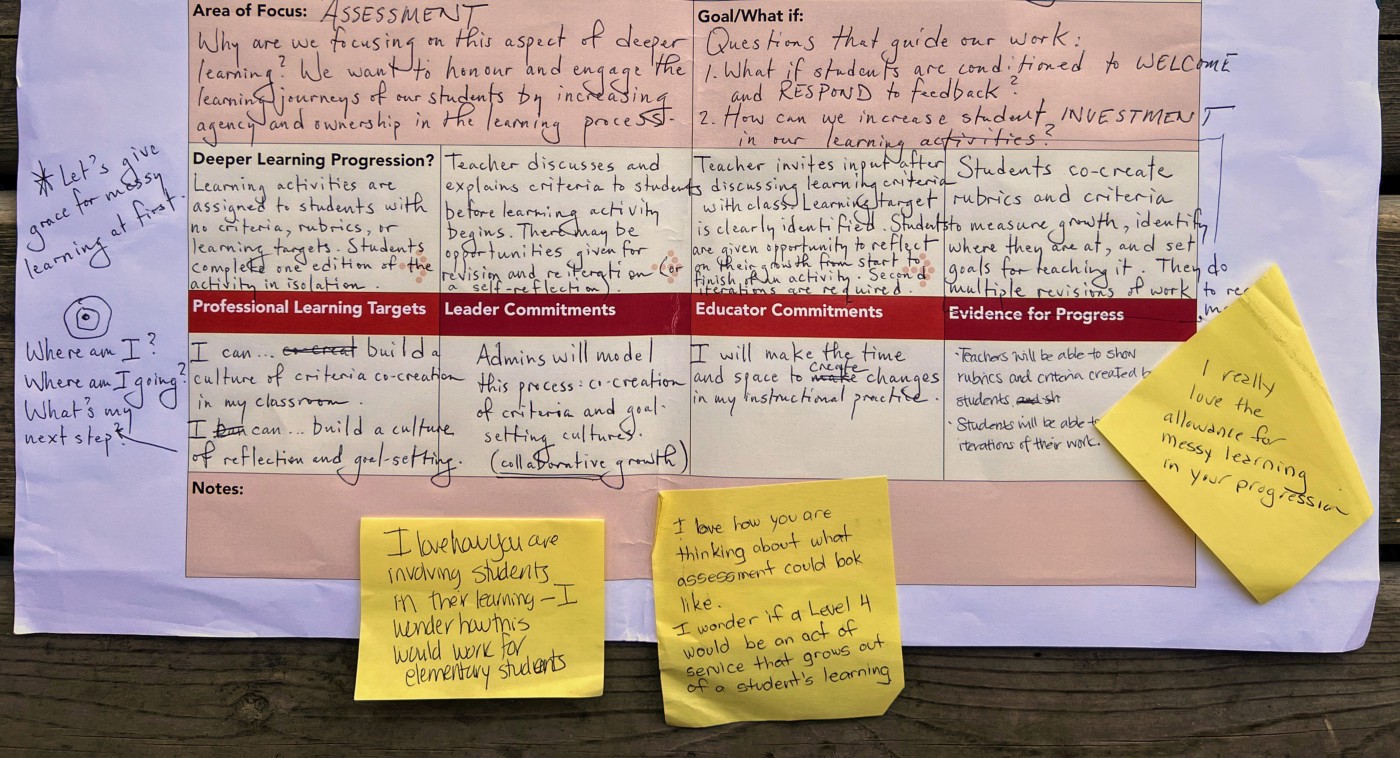
    Here’s what we came up with:

    • Step 1 (baseline): Learning activities are assigned to students with no criteria, rubrics, or learning targets. Students complete one edition of the activity in isolation (no follow-up).
    • Step 2: Teacher discusses and explains the assessment criteria to students before the learning activity begins. There may be opportunities given for revision and reiteration (or a self-reflection by students).
    • Step 3: The teacher invites input after discussing the assessment criteria with the class. The learning target is clearly identified. Students are given opportunity to reflect on their growth from start to finish of an activity. Second iterations are required.
    • Step 4: Students co-create rubrics and assessment criteria to measure growth, identify where they are in their learning, and set goals for reaching the learning target. They use peer feedback to complete multiple revisions of work in order to demonstrate mastery. They reflect on their learning throughout the creative process and identify goals for further growth.

    The arrows in the progression are hard to see, but if you look closely you can track the growth in the middle row from left to right.

    The post-its are bits of warm and cold feedback offered by other educators from around the country.

    It’s a thing of beauty.

    But, wait a second.

    The dream lesson plan

    Yes, the ideal lesson plans come with learning targets, success criteria, and assessment rubrics (co-created with students) in place.

    They activate prior knowledge, help students acquire and apply concepts, include adaptations that include all learners, provide means of formative assessment to inform teacher instructional decisions, and use anticipatory activities to set the stage for the next steps of learning.

    Wouldn’t that be wonderful if we could do that every class?

    Unfortunately, we can’t. Not every single time.

    And when we burden teachers with this list of ideals at every turn, I think we actually run the risk of limiting student learning.

    Sometimes, transformative learning appears in unexpected places.

    If you’ve been in the classroom for long, you know that some of your best ideas were born out of sheer impulse.

    That day that you slept in and walked into a class completely unprepared? Turns out you had an incredible epiphany that led to one of the best student-led learning activities that you ever came up with.

    Aiming for ideals but saving room for messy beginnings

    No, we don’t want last minute planning to be our standard operating procedure. But I believe we have to save space and give grace for messy beginnings.

    Because sometimes, that’s where our very best teaching and learning is born.