• Episode 76 – Kali Slusser

    76 - Kali Slusser.png

    Meet Our Guest

    KALI SLUSSER is an instructional coach, fitness obsessor, and kombucha fanatic! She is also a wife of a fellow teacher and a mom of three. Connect with Kali on Twitter @KaliSlusser and follow her ongoing book reviews with Greg Moffitt at https://readlikeapirate.wordpress.com/.

    Rethinking Careers

    Kali recalls the experience of being let go by a school district after twelve years of teaching. The school did not have a union and decided to lay off a number of teachers with seniority as a cost-cutting measure. Devastated and disillusioned, Kali started looking at a new career as a fitness instructor.

    Things changed quickly at the end of that summer when an administrator called to ask Kali to step into a classroom on an emergency basis – the school year was set to start in two days, and the school needed to fill a position in a hurry. Despite the abrupt transition, Kali found her footing that first year and continues to serve in the same school (albeit a different position) – six years later.

    The Journey of Read Like a Pirate

    The mission to partner with Greg Moffitt to read and review all of the DBC books at readlikeapirate.wordpress.com began three years ago when Kali first read Teach Like a Pirate. At the time, she tried to get a book club going in her school, but the idea received little interest and support.

    Later, she read Lead Like a Pirate, and soon decided that Greg (her principal) would thoroughly enjoy the read. She was right, and Greg didn’t stop there. He went on to read Innovator’s Mindset by George Couros, Culturize by Jimmy Casas, and other great titles from Dave Burgess Consulting.

    Inspired by the book reviews from Alicia Ray, Kali suggested to Greg that they also begin reading and reviewing the entire DBC series at a pace of one per week. The deal was struck, the blog was born, and so far these two educators have read and reviewed 19 books together.

    One of the reading tricks or hacks that Kali and Greg use is the iPhone accessibility (voice over) option, which can read out loud from the Kindle app.

    The Life of an Instructional Coach

    As an instructional coach, Kali follows the school’s professional growth cycle to support educators along their independent learning journeys. She coaches, plans, observes, and helps teachers reflect on their practice – the most important part of the coaching process. She also attends professional development events and presents her learning to the staff about once a month.

    Kali enjoys a highly collaborative relationship with administrators, who give her the room and flexibility to try new things and make adjustments in her role where appropriate. She calls the role a lot of fun and an amazing experience.

    What Excites Kali About Education Today

    Kali is excited and energized by the direction that education is moving. Today’s learning activities are less about memorizing facts and more about becoming an independent learner and problem-solver. It’s an exciting paradigm shift, and it’s been fun to observe these differences play out even in her own children.

    Professional Goal

    It’s been a challenge at times to shift her mindset from that of a teacher to a coach. She has to resist the urge to tell teachers “this is how you should be doing this” and instead pose reflective questions and help teachers come to new realizations on their own.

    Personal Passions and Productivity Hacks

    A couple of things that ignite Kali as a human being when she leaves the school are fitness and nutrition. Exercise fuels, relaxes, and energizes her. She enjoys taking care of herself and her family, and she tries to devote non-education reading time to these areas as well.

    Kali gets up at 5:00 a.m. on most mornings, grabbing an energy drink, getting dishes and laundry going, and starting her workout. It’s quality me-time that allows her to listen to podcasts and prepare mentally for the day.

    Voices & Resources That Inspire Kali’s Professional Practice

    On Twitter, Kali recommends following @JeffreyKubiak, another charismatic California principal who appeared on the Teachers on Fire podcast at episode 54. Jeff is awesome! Be sure to follow her amazing reading partner on Twitter as well. You’ll find him @Greg_Moffitt.

    Kali’s pick for edtech tools is Flipgrid, and perhaps no other platform is as good at increasing student voice and communication in your classroom. Follow Flipgrid on Twitter @FlipGrid.

    Outside of the books from Dave Burgess Consulting, Kali recommends The Boy Who Was Raised as a Dog: And Other Stories from a Child Psychiatrist’s Notebook–What Traumatized Children Can Teach Us About Loss, Love, and Healing by Bruce D. Perry.

    One podcast that is really grabbing the whole family’s interest when they’re in the car is Brains On! Check it out at https://www.brainson.org/.

    Over on YouTube, Kali’s go-to channel is the tried-and-true TED Talks. If you still haven’t subscribed, maybe it’s about time!

    When she finds time for some Netflix entertainment, Kali’s watching Grey’s Anatomy. The show has it all: humor, romance, adult storylines, and the reminder that there are other fields more stressful than education.

    We sign off on this fun conversation, and Kali reminds us of the best places to follow her online. See below!

    See more from Kali:

    Subscribe to the Teachers on Fire podcast on your mobile device.

    iTunes | Google Podcasts | Spotify

    Follow the Teachers on Fire podcast on social media.

    Song Track Credits

    Listen on YouTube and subscribe to the Teachers on Fire channel.

  • 33 Essential Quotes from Teach Like a Pirate

    See why this Dave Burgess classic is a must-read for educators.

    Image credit: Pixabay

    One of the amazing benefits of hosting the Teachers on Fire podcast is the opportunity to hear about the voices that are shaping the thinking and inspiring the practice of great educators around the world.

    In 2018, I first heard about Teach Like a Pirate from Adam Moler, an early guest on my show. Like many, my first reaction was skeptical. Who was Dave Burgess? And why would I ever want to teach like a pirate?

    As I hosted more guests and expanded my PLN, the endorsements didn’t stop. Eventually, I realized I needed to find out what Dave Burgess and his #TLAP community was all about.

    And I’m so glad I did.

    Dave is bold, engaging, and inspirational. Along with a host of practical ideas for learning activities, he challenges our assumptions, redefines our mission, and helps us dream again.

    If your passion for education could use some ignition, Dave is your guy and Teach Like a Pirate is your book. If you’re ready to reimagine your mission in the classroom, read on.

    33 Essential Quotes from Teach Like a Pirate

    1. Pirates are daring, adventurous, and willing to set forth into uncharted territories with no guarantee of success. They reject the status quo and refuse to conform to any society that stifles creativity and independence. They are entrepreneurs who take risks and are willing to travel to the ends of the earth for that which they value. Although fiercely independent, they travel with and embrace a diverse crew. If you’re willing to live by the code, commit to the voyage, and pull your share of the load, then you’re free to set sail. Pirates don’t much care about public perception; they proudly fly their flags in defiance.
    2. I’m passionate about creating lifelong learners. I’m passionate about increasing the self-esteem and self-confidence of my students. I’m passionate about having students leave my class with a larger vision of what is possible for their lives.
    3. To keep your passion for teaching alive, find as many ways as possible to incorporate your personal passions into your work.
    4. Passion is all about being on fire in front of your class.
    5. People are drawn in and love to be around those who are passionate about their lives.
    6. Don’t let the current overemphasis on standardized test scores lead to the loss of the teachable moment.
    7. Creative ideas don’t come out of the blue; they come from engaging in the creative process. That critical process starts when you ask the right types of questions and then actively seek the answers.
    8. Creativity is rarely about natural brilliance or innate genius. Much more often creativity results from properly directed attention, laser-like focus, relentless effort, and hard work. Outsiders see the glorious results but know very little about the blood and sweat that happens behind closed doors. Creative genius is something people tend to romanticize, but the reality is not very romantic at all. Like any skill it takes practice and effort.
    9. Education can be used to uplift and inspire or it can be used as a hammer to bludgeon and beat down. We must collectively agree educating the next generation is worth the time and effort and that our students deserve to be uplifted and inspired.
    10. If you haven’t failed in the classroom lately, you aren’t pushing the envelope far enough. “Safe” lessons are a recipe for mediocrity at best.
    11. The key to failing without quitting is to shift your paradigm to believe there is no such thing as true failure — only feedback.
    12. Spend more time on your passions, hobbies, and outside areas of interest and then seek ways to incorporate them into your classroom. Cultivate new hobbies and watch new areas of your brain explode in creative output.
    13. Grow! Try new things and do those bucket-list items. Notice the world around you and treat it like the bountiful supply of creative ideas that it is. It’s not just good for your life…it’s great for your teaching. Exploring the world and your passions allows you to bring a new perspective and energy into the classroom. It allows you to become a powerful role model for your students. We always say we want them to be life-long learners, so we must show them what that looks like.
    14. I believe the best books to read about teaching are rarely in the education section. I always have three or four books on my nightstand, a book in my car, one in my school bag, and several more on my phone. I consider it one of the most important parts of my job to constantly expose myself to the high quality thinking of other people.
    15. When I only focus on my teaching, I am not nearly as creative as when I find time to humor my strange obsessions.
    16. Don’t fall into the trap of thinking time spent developing yourself into a well-rounded person, above and beyond your role as an educator, is wasted or something to feel guilty about. It is essential and will pay dividends in not only your life, but also in your classroom.
    17. If you can’t explain why someone should pay attention to what you’re saying, maybe you shouldn’t be saying it.
    18. By lighting yourself on fire with enthusiasm, you can become a beacon of bliss amidst a bastion of boredom and banality.
    19. It doesn’t particularly matter what the subject is; our mission is to teach in such a way that who we are as human beings has a more powerful and lasting effect on students than what we say.
    20. As for the side dishes and dessert, those are the parts of your lesson only the uptight and misguided view as a waste of time. There is no award given to the teacher who fills every class period with bell-to-bell direct instruction. It doesn’t matter how much material you teach, it only matters how much is received.
    21. No content standard in any class at any level is more important than nurturing and building a love of learning. Designing a class that empowers students to become life-long learners, avid readers, and voracious seekers of knowledge, will have an impact that reverberates for a lifetime and beyond.
    22. Much of your success as an educator has to do with your attitude towards teaching and towards kids. The rest of your success is based on your willingness to relentlessly search for what engages students in the classroom and then having the guts to do it.
    23. Sometimes it’s OK to do things in class because it increases the fun factor and fosters positive feelings about school.
    24. We have unbelievably talented kids sitting in front of us and many are starving for the opportunity to display their creativity. We should do everything we can to provide them the opportunity to hone their artistic skills and create.
    25. After finishing a unit, I often provide a day for students to get into collaborative groups and create non-linguistic representations of the material. For example, I may ask them to create a visual depicting an event or concept. It can be a literal interpretation or a symbolic representation; I encourage my students to be as creative as possible.
    26. Whether you use it to create a mood or tie it into your curriculum, music is an element of presentational power that can help you transform your class.
    27. When used correctly, technology can enhance the effectiveness of your lesson, increase engagement, and even strengthen the relationships between the humans that comprise your class.
    28. Technology as a replacement for live interaction between teachers and students concerns me.
    29. Our economy no longer rewards people for blindly following rules and becoming a cog in the machine. We need risk-takers, outside-the-box thinkers, and entrepreneurs; our school systems do the next generation of leaders a disservice by discouraging these very skills and attitudes.
    30. To ascend to the level of greatness, you have to be on fire with passion and enthusiasm. Mediocrity is incapable of motivating. You just can’t be on fire about mediocrity. There’s no energy, no juice, and no fuel to ignite action.
    31. We’re skyrocketing forward into an educational landscape that is changing every day. In these exciting times, we must be ready to take on the challenge of redefining greatness for a whole new generation of teachers and students.
    32. We aren’t just teaching facts to memorize or skills to learn; we’re uplifting lives and helping students fulfill their human potential. We’re shaping the mothers, fathers, world leaders, entrepreneurs, and artists of tomorrow.
    33. “Starting” may well be one of the most difficult and under-appreciated skills of all.
  • Episode 75 – Annick Rauch


    75 - Annick Rauch

    Meet Our Guest

    ANNICK RAUCH is a Grade 1 French immersion teacher in Winnipeg, Manitoba, Canada. She’s a loving mom to 4 boys and wife to the man who allows her to do it all. Her passions in education include growth mindset, global collaboration, and all things innovation. You can follow her on Twitter @AnnickRauch and visit her blog at http://www.annickrauch.ca/.

    A Bump in the Road

    Annick recalls a moment last year when a live on-screen image search in front of the class went wrong. After her initial alarm and concern, she carefully debriefed the incident with her learners and emailed parents to explain what had happened. Parents were surprisingly thankful for the way that she handled the unfortunate surprise and the lessons students took away from it. Read Annick’s full reflection on this situation at her blog.

    Seesaw in the Language Classroom

    As a language teacher, Annick loves what Seesaw offers in terms of helping students represent their learning and connect with parents. Although most of her students don’t come from francophone homes, Seesaw gets parents engaged in the learning process and is a great tool for documenting and curating the learning journeys of her students.

    The Growth Mindset and YouTube Read-Alouds

    Annick has done a lot of work with her learners around growth mindset. She sees it as an essential life skill – young learners need to grasp the Power of YET in order to help them develop grit and resilience in their approach to difficult learning challenges. Annick has helped to organize growth mindset read-alouds, featuring different classes reading through great children’s books that illustrate growth mindset. Her classes have also connected globally with other classes and authors around the world, giving these activities even more interest and impact.

    Check out one example of these growth mindset read-alouds on YouTube: It’s Okay to Make Mistakes.

    The Impact of Authors from Dave Burgess Consulting

    Authors like Jennifer Casa-Todd, George Couros, Tamara Letter, Paul Solarz and many others have all been instrumental in Annick’s personal and professional learning journey. They all have one thing in common: they’ve published books through Dave Burgess Consulting.

    Annick recalls how a learning conference at High Tech High in San Diego first connected her with Twitter and Learn Like a Pirate, by Paul Solarz. After learning from the book, Annick tweeted out a snippet from her learning, and the Solarz actually responded! Encouraged by this connection, Annick went on to read The Innovator’s Mindset, Teach Like a Pirate, A Passion for Kindness, and other best-sellers from DBC.

    She’s thankful for the support she’s received from these authors and encourages other educators to experience the same sort of support and inspiration. “Just pick a book that interests you … and get connected with the author,” she says.

    Passions and Professional Goals in Education

    Annick is thrilled today by the incredible new opportunities for global collaboration in education. She talks about her recent connection with Karen Caswell in Australia and the opportunities she’s had to bring authors like Tamara Letter and Dave Burgess into her classroom via Google Hangouts.

    This year, one of Annick’s biggest professional goals has been to develop the Optimal Learning Model (from Regie Routman) in her practice. She’s been getting together a few times a year with a small group of educators who are also working on this model, and she’s also been able to learn a lot from co-teaching with another teacher immersed in the model. She’s been able to implement what she’s learned in two incredible writing projects, and she’s been blown away with the learning and progress demonstrated by her first graders. See a recent exhibition of their learning.

    Personal Interests Outside of the Classroom

    Annick has been a writer since she had the first of her fourth boys. Her writing has moved from emails to keepsake books to her blog. Most of her blogging has been about education, because learning remains one of her chief passions. Writing has definitely been a source of energy and motivation for her ever since those early emails, and she plans to continue this practice.

    Secrets of Annick’s Productivity

    Annick relies on a few things to keep her healthy, inspired, and productive. Her husband is a key support on the home front, looking after dinners every day and supporting her in many other ways.

    She’s also a goal-setter, and she’s found great success by setting simple, attainable goals. That attainable part is key – it’s better to run for at least ten minutes than not run at all.

    Another productivity hack is list-making: she thrives on lists and will even write in list items after they’ve been completed, just so she can cross another item off.

    Annick has also added more support at home by hiring some cleaning help. She and her husband really appreciate the time and energy gained from this decision and consider it a good investment in quality of life.

    Voices & Resources That Inspire Annick’s Professional Practice

    On Twitter, Annick’s been gaining tremendous inspiration from @TamaraLetter. Annick also wrote a personal endorsement for Letter’s A Passion for Kindness and recommends it as an essential read.

    If you’re looking to start reading education books from Dave Burgess Consulting, Annick recommends starting with the title that began it all: Teach Like a Pirate. Follow the author, Dave Burgess, on Twitter @BurgessDave.

    Over on YouTube, Annick recommends subscribing to John Spencer. His channel is full of short, pithy, inspirational messages for educators. Few education channels offer more value! Follow the channel creator on Twitter @SpencerIdeas.

    On Netflix, Annick is gaining inspiration from Heal and reliable amusement from Life in Pieces.

    We sign off on this conversation, and Annick lets us know where we can see more from her online. See below for details!

    See more from Annick:

    Subscribe to the Teachers on Fire podcast on your mobile device.

    iTunes | Google Podcasts | Spotify

    Follow the Teachers on Fire podcast on social media.

    Song Track Credits

    Listen on YouTube and subscribe to the Teachers on Fire channel.
  • Just Start: Get on the Track of Improvement

    By settling for safety, we miss out on certain growth and learning.

    Photo by NordWood Themes on Unsplash

    “Fear is always triggered by creativity, because creativity asks you to enter into realms of uncertain outcome. This is nothing to be ashamed of. It is, however, something to be dealt with.” — Elizabeth Gilbert

    At the outset of the new year, AJ Juliani issued a challenge to the education world: blog — or engage in blogging activities — for thirty days.

    His call was a welcome one. Research has long been telling us that our students learn best when they are given the time, tools, and opportunity to reflect thoughtfully on their own learning journeys. In Leaders of Their Own Learning, Ron Berger calls this sort of metacognitive activity “writing to learn.”

    The same principle applies for educators.

    Writing to Learn and Learning to Write

    The more we speak, write, tweet, vlog, and publish about our learning and professional practice, the more we will learn, grow, and develop as educators. And as we make our own learning visible, others benefit and grow as well.

    John Hattie talks about the power of collective efficacy. Stephen Covey calls it win-win. Simply put, we’re better together.

    Our professional growth isn’t just about reading and listening to the established voices in education. It’s also about sharing and contributing our own experiences.

    So, as passionate educators, why don’t we participate in the global conversation more than we do?

    It’s Not Really About Time

    The typical response says we don’t have enough time in the week. But for most, that’s not actually the case. As Laura Vanderkam demonstrates convincingly in 168 Hours: You Have More Time Than You Think, most of us actually do have the time.

    When you get right down to it, most of us aren’t hitting ‘Publish’ for one reason: fear.

    We fear embarrassment. Rejection. Crickets.

    We assume that our voice doesn’t matter. That no one will pay attention. Or worse yet, that we’ll be exposed as an imposter.

    As Elizabeth Gilbert points out, most of us don’t publish creatively because the outcome is uncertain. There’s just no guarantee of success — whatever success means.

    So we take the safe option.

    The Power of Practice

    But people who aren’t publishing are overlooking an absolute guarantee: improvement.

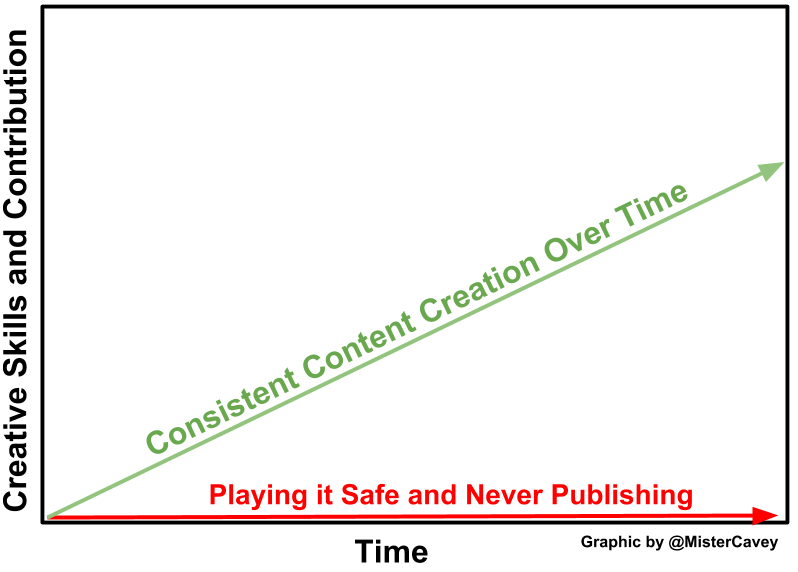
    That’s right, I said it. When you create content consistently over time, your growth and improvement is guaranteed. You can’t help but get better.

    In Outliers, Malcolm Gladwell makes the case that repetition is highly underrated. He tells story after story of individuals who simply put in the time on their craft to gradually become an expert in their space.

    Marques Brownlee

    Earlier this year, I listened to a podcast featuring YouTuber Marques Brownlee, a soft-spoken, thoughtful, and charismatic tech reviewer. He talked about how he began publishing YouTube videos back in high school simply because he loved the medium and enjoyed the process. As he describes it, his first 100 videos were viewed by audiences of around 100 people.

    Today, Brownlee’s videos earn millions of views apiece. He has 7.7M subscribers.

    It’s not all about growing an audience. That’s not really my point, although the size of his growing viewership does speak to the value of his work.

    What I’m more interested in is those first 100 videos. Just think about the sort of headspace he was in to continue creating.

    As he puts it, he created content simply because he enjoyed it. The views and reactions were secondary.

    And because he stuck with it, he’s obviously eclipsed Gladwell’s 10,000 hours. He’s become a master at his craft.

    The Teachers on Fire Podcast

    In March of 2018, I realized a long-held dream by launching a podcast for educators, Teachers on Fire. I didn’t really know what I was doing, and I had questions about everything from applications to equipment to guests.

    It took a lot of work to get started, and it definitely wasn’t easy. My sound quality was awful at the beginning, and I made a ton of unfortunate mistakes that made the process even more painful.

    The interview for my very first episode took forever to complete because the recording app I was using crashed at least six times. It was a frustrating first experience.

    Almost a year later, I still don’t have it all figured out. But I’m learning. I’m growing. I’m improving my craft. I’m miles and miles from where I started, and my conversations with education leaders are inspiring listeners around the world.

    Consistent Content Creation is a Direct Line to Improvement

    I don’t consider myself a skilled artist. But I have zero doubt in my mind that if I set aside three hours a weekend to learn and practice pencil drawing for 52 weeks, I would be a much better artist by year’s end.

    Absolutely no doubt in my mind.

    I’m convinced that the same holds true for any kind of creative publishing. Once we embark on the commitment of regular creation, improvement isn’t a question. It’s an absolute certainty.

    And as we hone our creative skills, our contributions to the world around us become more valuable.

    This is what I want my stepsons to know. My students to know. And you, fellow educator, to know.

    We can lament our lack of creative skills. Or we can take action.

    Just start.

  • Episode 74 – Susan Jachymiak

    74 - Susan Jachymiak.png

    Meet Our Guest

    SUSAN JACHYMIAK is a 4th grade teacher in Orland Park, IL. She’s a rookie this year, and she’s clearly on fire! Follow her on Twitter @MsJachymiak and visit her blog at http://msjachymiak.weebly.com.

    Rookie Year Challenges

    Susan’s teacher training focused on middle school education, but her first teaching position has been at the fourth grade level. These students come with different learning and social needs than students in middle school, so it’s taken some professional growth for her to better understand the dynamics of these younger learners and meet them where they are.

    #NewTeacherJourney and the Power of Twitter

    As Susan started plugging into Twitter chats before her first year of teaching, she noticed a shortage of chats dedicated to rookie teachers. That led her to create the #NewTeacherJourney chat, which typically connects on Sunday evenings at 8:30 pm EST. She’s been pleased to see the number of other new teachers plugged in, connecting, and gaining encouragement and advice thanks to this hashtag.

    Susan is a strong advocate of using Twitter – not only for the purposes of connecting socially with other educators, but in order to leverage the power of the platform by actively sharing and learning from what is happening in classrooms around the globe.

    Passions in Education

    What excites Susan about education today are the amazing opportunities that technology is allowing learners in her classroom. She uses GoFormative to facilitate exit slips as checks for understanding at the end of lessons, Prodigy to reinforce Math concepts, and Mystery Skype to reinforce critical thinking and geography skills.

    Her professional goal for the rest of this year and going into next year is focused on organization, including what to collect from students, how best to arrange it, and how best to act on it. Because so much of teaching requires thinking on your feet and making quick decisions – especially during your first year – it’s been a challenge to find the systems that work most efficiently for her. Ultimately, better organization will set her up to better meet the unique needs of each of her learners.

    Susan has also been fascinated by the possibilities for learning articulated by Jo Boaler in her book, Mathematical Mindsets. In the Math classroom, this helps students understand the power of “I don’t get this … YET,” seeing initial failures as merely first attempts in learning, and adopting practices of continuous revision to improve first attempts and learn toward mastery. These concepts don’t just apply to students – they apply to educators as well!

    Productivity and Recharging

    Susan is a list-keeper, and for that purpose her app of choice is Google Keep. Keep is where she goes to determine what still needs to get done, what is a higher priority, what needs to be added to the list, and what needs to come off. She also recharges her professional passion in Twitter chats, and she makes it a goal to participate in at least one of those per week.

    Voices & Resources That Inspire Susan’s Professional Practice

    On Twitter, Susan suggests following @RaeHughart. Rae shares a lot from her practice, offers great resources from the Teach Better Team, and co-hosts the Teach Better Talk podcast.

    For edtech tools, Susan recommends Class Dojo as a means to build class culture and encourage collaboration toward group goals. She also points out Plickers as a fun way to quickly and efficiently collect feedback and formative assessments across the class using your mobile device.

    Susan’s writing has already appeared in a published book! It’s called Chasing Greatness: 26.2 Ways Teaching Is Like Running a Marathon by Mike Roberts. Follow the author on Twitter @BaldRoberts.

    Two educational podcasts that Susan is listening to are Teach Better Talk and The Pondering Education Podcast.

    Over on YouTube, Susan is tuned into a channel called Pocketful of Primary, hosted by Michelle Ferré. On her show, Michelle shares all the ups, downs, and ideas from her work, and Susan gleans things of value from every episode.

    On Netflix, Susan enjoys two classic series: Fuller House and Friends.

    See More From Susan

    Subscribe to the Teachers on Fire podcast on your mobile device.

    iTunes | Google Podcasts | Spotify

    Follow the Teachers on Fire podcast on social media.

    Song Track Credits

    Listen on YouTube and subscribe to the Teachers on Fire channel.