
• Why I’m Livestreaming Every Saturday Morning on YouTube

    Weekly interviews with educators don’t bring the biggest views, so why bother?
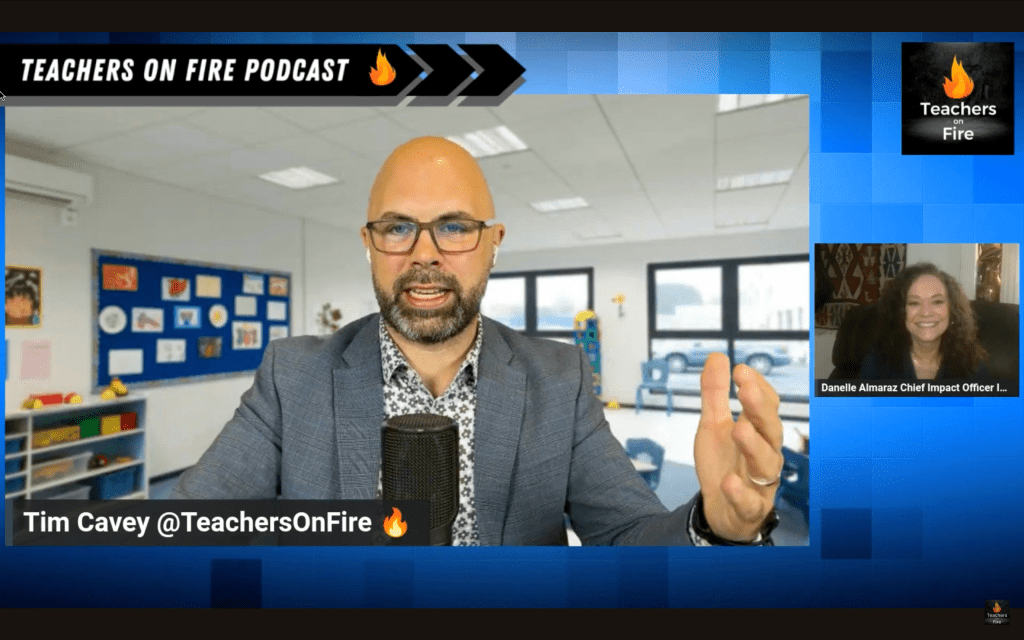
    I’m a passionate education leader and content creator.

    • I love writing blog posts about education.
    • I love facilitating conversations with other education leaders.
    • I love recording helpful video content and tutorials for teachers.

    These activities give me joy and fulfillment.

    Maybe you enjoy creating some of the same, or maybe you’re simply a consumer.

    Or maybe you’re a consumer who would like to become a creator.

    Either way, I think you’ll find this exploration helpful.

    My YouTube journey

    YouTube has been a fun hobby for me over the past six years. My content has slowly evolved and improved over time, and it still has a long way to go.
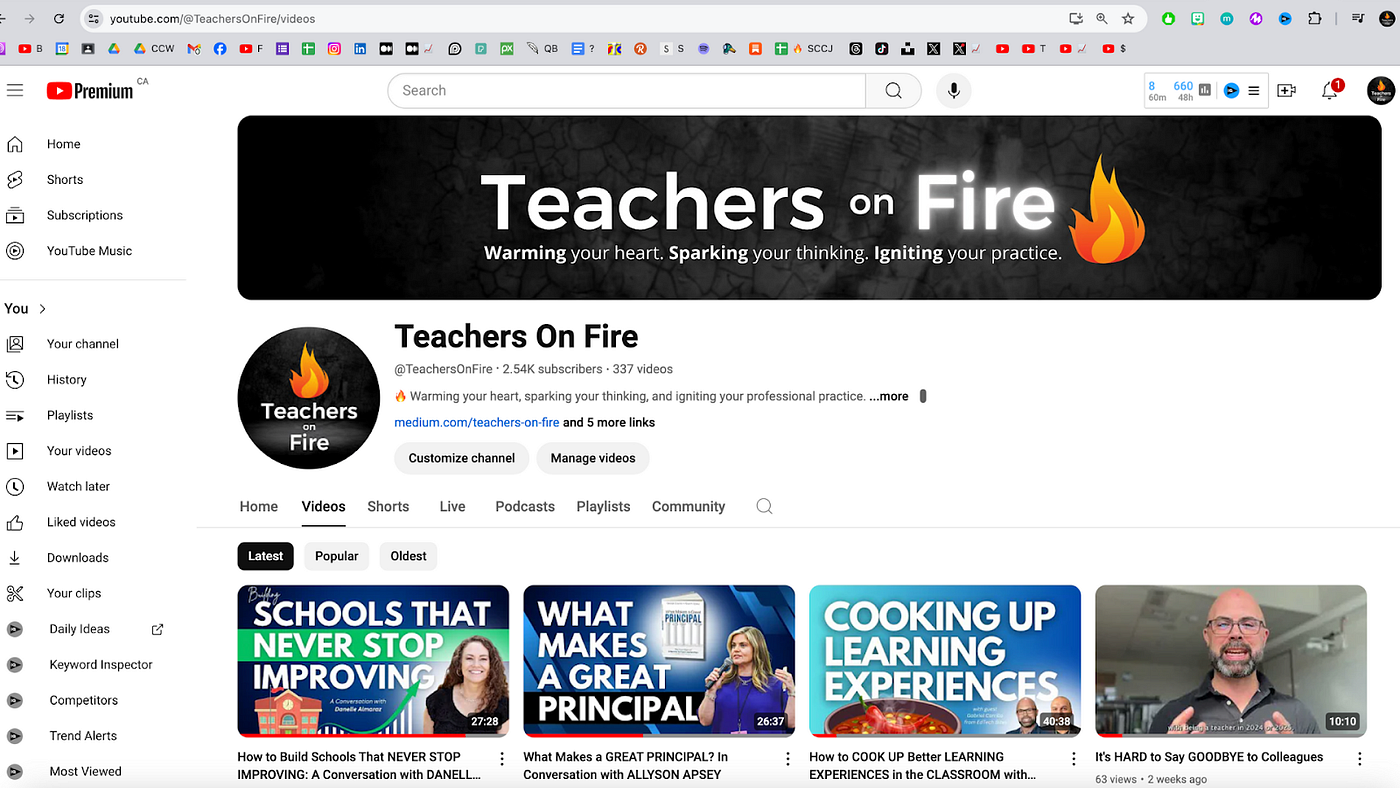
    I’ve experimented with a few different kinds of content.

    Back in 2018, I began with audio-only content: still images with audio versions of the Teachers on Fire podcast running behind them.

    Weirdly, these “videos” attracted some views (really listens), encouraging me to keep going.

    From there, tried some vlogs — direct speaking to camera.

    Then I tried edtech tutorials.

    Then COVID came along, and I started experimenting with livestream conversations on a platform called StreamYard.

    My 337 videos have been viewed over 300,000 times, earning me the trust of more than 2,540 subscribers. These numbers are teeny-tiny in the world of YouTube, but they also represent levels of success that I once considered impossible.

    Most of my content today consists of livestreamed interviews with other education leaders. I try to go live every Saturday morning at 8am Pacific and 11am Eastern with an educator who inspires me in some way.

    But here’s the tension, and the reason for the title of this piece: in terms of growing my channel through views and subscribers, these interviews offer an absolutely terrible ROI.

    Horrible.

    Confused? Let me explain.

    Why edtech tutorials make excellent YouTube content

    To start to understand why K-12 education interviews perform poorly on YouTube, let’s contrast them against another kind of YouTube content that I create: edtech tutorials.
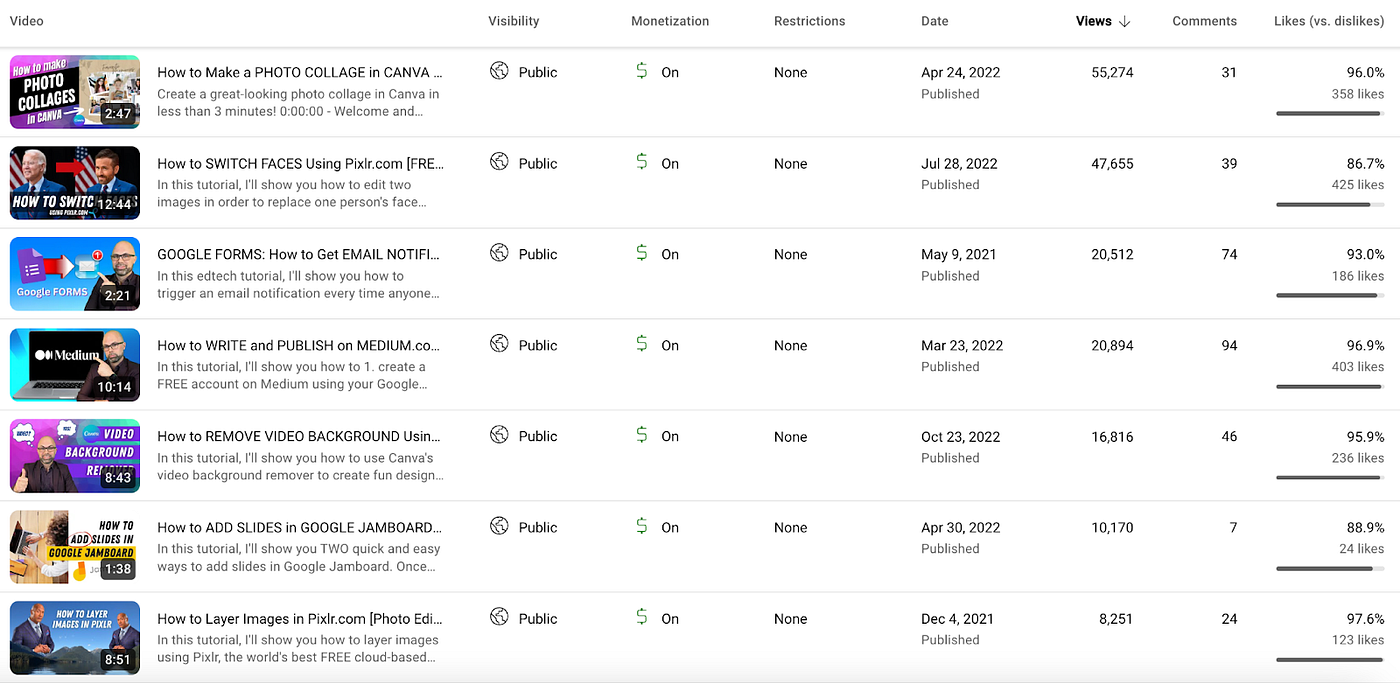
    All my heavy-hitting videos on my channel are edtech tutorials. ALL of them.

    Why?

    It comes back to a YouTube strategy that I first learned at Think Media: ASQ.

    Answer simple questions.

    When I take the time to answer teacher questions by creating simple how-to video solutions, those videos inevitably perform well.

    • They solve some sort of an immediate, practical problem. Problem → solution.
    • They have great SEO (search engine optimization), meaning the titles of these videos are highly searchable.
    • They are evergreen, meaning views can often continue and in fact grow larger as weeks, months, and even years drag on.

    The best of these videos never die — they just keep going and going and going, because demand continues over time.

    And the best part?

    They’re easy to make.

    They don’t take much time. They don’t rely on anyone else. They require no booking, no communication with another party, and little preparation.

    Just screen record, edit, and publish.

    All told, I can make these videos in about 20% of the time it takes me to publish a conversation with another education leader. Conversations, by comparison, lack the powerful features (solution, SEO, evergreen) that make tutorials so popular.

    So why bother with interviews?

    Why do I continue to record conversations with other education leaders every Saturday morning, even when they require more time to plan, prepare, execute, edit, and publish?

    Am I wasting my time and energy?

    I think not, and here’s why.

    5 reasons why I’m livestreaming conversations every Saturday morning on YouTube

    1. It’s fun.

    Going live remains a thrill.

    My streaming service, StreamYard (not sponsoring this post), allows me to stream live on YouTube, LinkedIn, Facebook, and X at the same time.

    It allows viewers to interact live with the show, my guest, and our conversation in the live chat. I can display comments on screen.

    It’s a ton of fun, so that’s reason number one.

    2. Forced consistency of output

    I actually quit recording and publishing interviews on my YouTube channel for close to two years between September 2021 and September 2023.

    My thinking at the time? Focus less on my podcast (think audio-only content on podcast apps like Apple Podcasts) and more on the YouTube channel.

    Quitting weekly interviews gave me a lot more discretionary time, that much is true.

    No longer did I need to wake up early on Saturday mornings to meet other educators online. I was free to sleep in and get up on my own schedule. Free to create the content I wanted when I wanted.

    And that strategy wasn’t a complete disaster. To an extent it worked, and I was able to create some good content during this period.

    But I wasn’t consistent. I could go weeks at a time without creating a video.

    During those creation droughts, I wasn’t offering value. I wasn’t visible. I wasn’t consistent.

    As a result, I wasn’t building the views and subscribers I needed to grow. In my periods of silence, my viewers and listeners were turning to other creators they could count on to create consistently, and rightly so.

    There’s also a rule in the world of content creation that the longer you go without creating, the harder it is to create.

    This might sound silly or insignificant, but creators know what I’m talking about. It’s like building a psychological wall between you and the content: with every day that passes, another brick goes up.

    Resistance strengthens, and two weeks become four.

    In contrast, when I schedule weekly interviews with other educators, I’m making a non-negotiable contract with myself.

    I MUST show up. I MUST get in the chair. I MUST hit Record and create.

    Because if I don’t, I’m not just letting down myself. I’m letting down another educator that I respect a great deal.

    I’ll do everything in my power to avoid that, and consistency is the result.

    Thanks to weekly interviews, I’m never silent on YouTube for more than seven days.

    3. These conversations build relationships with other education leaders

    Podcasting is twenty years old now, but there’s still a magic in this space that remains a secret to most of the general public.

    Imagine being able to speak 1:1 with just about any leader, author, or thought leader in your space. For free.

    This is the power of podcasting.

    If I call a high-profile education author and ask if we can chat on the phone for 30–40 minutes for free, that’s a pretty steep ask.

    But if I invite them to join me on my podcast, I usually get a very different response.

    They inevitably say yes. We chat. I publish and promote the content in video and audio forms.

    And in the process, we build some know-like-trust with each other. We have some memories, smiles, and personal exchanges to forever match with the name and face.

    If I do my job, I support my guest’s work by shining a light on their content.

    And if I serve my guest well, they are more likely to speak well of me and my podcast in their circles.

    It’s a win-win, and it often leads to relationships that last for years to follow.

    4. Weekly livestreams build community for teachers — a weekly meeting space

    By scheduling these conversations every Saturday morning, I’m creating a reliable time and place for educators to visit that allows them to connect with other like-minded professionals.

    I’ll be there. Another education leader will be there. And viewing educators will be in the live chat.

    It takes time, work, and consistency to build this kind of weekly gathering, but it’s a beautiful thing when it happens.

    To see two shining examples of this on YouTube, check out Principal Baruti Kafele’s AP and New Principals Academy or Real Rap with Reynolds by C. J. Reynolds.

    Both education leaders have been hosting weekly livestreams for years, and the communities they’ve built are incredible.

    Teachers value community spaces that meet consistently and bring reliable value.

    That’s what I’d like to build, too.

    5. My weekly professional development

    I love to read books written by educators, but conversations spark my thinking in ways that reading simply cannot.

    Each guest has inspired me in some way before they come on my show. I select most of them myself — I’ve learned to deny the vast majority of appearance requests.

    I choose guests that I know are knowledgeable, generous, good communicators, and bring a particular expertise to the conversation that I am sure to benefit from.

    As a result, my thinking is sparked, my views are challenged, and my understanding is expanded every single week.

    No weeks off means no mental or professional atrophy. I’m always growing, reflecting, and learning.

    It’s a virtuous cycle that makes me a better podcast host and blogger for Teachers on Fire. Even better, it allows me to contribute more to my own community.

    Imagine a hobby that makes you better at your Monday-Friday job. That’s exactly what this is.

    I know that’s not for everyone, and no, not every hobby should support your primary work. I’m a huge believer in creating for the intrinsic fulfillment of the creative process.

    But there’s a symbiosis here that I find deeply satisfying.

    My contractual work gives me more to offer my podcast audience. My podcast work gives me more to offer my elementary school community.

    I’m not just growing a YouTube channel. I’m growing my impact and influence.

    Final thoughts

    Look, weekly livestreaming is a serious commitment.

    Guests don’t just appear. Connections and arrangements must be made. The stage must be set. Research must be done and questions must be planned. Episodes must be promoted before and after the event. Editing must be completed. Publication and distribution take time.

    But for the time being, I like the equation. I see how this habit serves me and the educators around me.

    These conversations won’t produce big-time views and subscribers for my YouTube channel.

    But they’re worth it.

  • How to Build Schools That Never Stop Improving with Danelle Almaraz

    The Chief Impact Officer at InnovateEd talks about building system-wide agency in our schools.

    🔥 What does it mean to lead from the middle?

    🔥 How can we empower students and build student agency in 2024?

    🔥 How can we build systems of continuous improvement in our schools?

    Join me for this conversation with education leader DANELLE ALMARAZ as she shares her insights on these and other questions.

    About This Guest

    With a focus on continuous improvement, Danelle equips leaders with the tools and mindset needed to enact lasting change by leading from the middle. Leadership development programs at InnovateED are designed to instill a culture of collaboration, innovation, and growth, empowering educators at all levels to lead with purpose and vision.

    Connect with Danelle 

    on LinkedIn, on X @AlmarazDanelle, on Instagram @dalmaraz007,  and at https://innovateed.com/.

    In This Conversation

    0:28 – Who is Danelle Almaraz?

    1:40 – A story of a reprimand from school administrators

    5:07 – Danelle describes the vision for schools at InnovateEd

    6:21 – What is it important to lead from the middle in our schools?

    10:03 – How students can empower students and build student agency

    11:53 – Danelle’s work with schools in Africa 

    13:31 – Spirals of inquiry in professional development

    14:58 – A school that is getting it right: Park City, Utah

    16:23 – A passion outside of professional learning: Math

    17:15 – A productivity hack: collecting MVPs – Most Valuable Points

    20:24 – An edtech tool that Danelle is loving: Perplexity.AI

    21:38 – Book recommendations: Schools on the Move, Leading the Whole Teacher

    22:40 – Inspiring Danelle on social media: Catlin Tucker, Katie Novak

    23:41 – Guest suggestions: Hakeem Subair, Kyle Wagner

    24:10 – What Danelle’s watching for fun: the Dodgers!

    24:51 – How to connect with Danelle and InnovateEd online

    Mentioned in this episode: Perplexity.AI, Allen Westover, Christopher Steinhauser, Allyson Apsey, Catlin Tucker, Katie Novak, Kyle Wagner, Hakeem Subair 

    Song Track Credit

    Tropic Fuse by French Fuse

    GO! by Neffex

    *All songs retrieved from the YouTube Audio Library at https://www.youtube.com/audiolibrary/.

  • 5 Ways to Crush Your Next Video Conference or Podcast Interview

    Whether you’re on Zoom or recording a podcast, here’s how to show up.

    Thanks to the nightmare of 2020, we’re all video conference pros, right?

    Wrong. What changed is that we all know how to use Zoom.

    Where are we now? For many of us, it’s pretty blah. Mediocre at best.

    We know how to activate VC tools and select AV inputs, but that’s about it.

    So the time has come to take things to the next level, fellow educator. Elevate your video conference game and crush your next podcast appearance with these 5 tips.

    1. Look directly at the lens — not the screen.

    This feels counter-intuitive, but try to limit how much you look at yourself or the host while you’re listening and speaking.

    Think of it this way. Imagine standing F2F with someone who refused to make eye contact and looked at your waist the whole time they were speaking.

    It’s weird and not very compelling.

    Looking at the lens = making eye contact with your audience.

    Just as IRL, it’ll make a world of difference.

    2. Position your lens (camera, phone, or webcam) at eye level.

    Friends, it’s time to move on from the laptop on the desk or table in front of us. In case you haven’t noticed, that’s not a flattering angle for anyone.

    Using a laptop webcam? Fine. But put your laptop on a shoebox or a pile of big books.

    Using a phone or camera? Put it on a tripod.

    Go eye to eye with your viewer. Trust me.

    3. Use hand gestures.

    They serve as pattern interrupters, helping to maintain the viewer’s attention.

    Contrast dialogue with hand gestures versus motionless talking heads, and you’ll quickly see the difference.

    4. Limit responses to 1–3 minutes whenever possible.

    Less is more.

    We all want to bring maximum value as a guest, so the urge can be to spill every possible thought that comes to mind. I’ve been guilty of this many times.

    But droning on and on is a buzzkill. I’ve had well-meaning guests take a question and run with it for over ten minutes.

    People just don’t have the attention for that.

    As Sean Cannell from Think Media likes to say, be brief, be bright, be fun, and be done.

    5. Smile, enjoy yourself, and be human.

    The goal is not to be flawless.

    To aim for absolute perfection is to ratchet up the anxiety and tension. And when you do that, you’re no fun.

    Captain Serious is never the most effective speaker.

    The truth is that your imperfectly delivered anecdotes are more valuable than you think. Your quick one-liner may be just the chuckle or disruptor that a tired listener needs.

    Shoot from the hip, be genuine, and don’t hide the spicy takes — it’s the edgy answer that is often the most interesting.

    What am I missing?

    Listen, I don’t nail all of these myself. But after 300 episodes on the Teachers on Fire podcast, I know how much they matter.

    Try them, colleague.

    Am I missing any critical ones? A runner-up item that I decided not to include in this list: avoid using bluetooth audio inputs. Your laptop’s internal microphone will usually beat your bluetooth device for quality.

    If you’ve got another one for me, I’d love to hear it. And if you find one or more of these tips helpful, let me know in the comments below.

    Until next time, good luck at your next video conference or podcast recording, colleague.

    The world needs to hear from you.

  • What Makes a Great Principal? A Conversation with Allyson Apsey

    🔥 What does a school culture of leadership look like?

    🔥 What are the five pillars of effective school leadership?

    🔥 What do teachers want more from their principals: presents or their presence?

    Join me for this conversation with education leader Allyson Apsey as she shares insights on these and other questions.

    About This Guest

    Allyson has been an award-winning school leader for nearly 20 years, leading all levels from elementary to high school. She is the author of several books—including What Makes a Great PrincipalLead with Collaboration and Leading the Whole Teacher. She currently serves districts, schools and organizations throughout the country as a keynote speaker, professional learning provider, and an Instruction and Leadership Coach with Creative Leadership Solutions.

    Connect with Allyson on LinkedIn, on X and Instagram @AllysonApsey, and at her website, https://allysonapsey.com/.

    Tune in for my regular Teachers on Fire interviews, airing LIVE on YouTube every Saturday morning at 8:00am Pacific and 11:00am Eastern! Join the conversation and add your comments to the broadcast.

    In This Conversation

    0:28 – Who is Allyson Apsey?

    1:33 – Allyson’s experience with Imposter Syndrome

    3:43 – How did ‘What Makes a Great Principal’ happen and who is it for?

    7:33 – What are the Five Pillars that make a principal great?

    8:23 – How administrators can tap into the wisdom of teachers in their buildings

    11:54 – What does a school culture of leadership look like and how do we build it? (shoutout to Dr. Ryan Daniel)

    12:58 – Encouragement for tired administrators who find it hard to be present

    16:34 – How to begin building staff culture at a new-to-you school

    19:20 – Other personal passions: history, documentaries, and people

    19:57 – A productivity hack: writing when she’s feeling it

    20:53 – An app pick: Canva

    22:14 – A book recommendation: Lead Like a Pirate

    23:20 – Someone to follow: Jessica Cabeen

    24:06 – A future guest suggestion: Jessica Gomez

    24:45 – What Allyson is streaming during her down time

    25:11 – Where to connect with Allyson online

    Mentioned in this episode: George Couros, Livia Chan, Dr. Ryan Daniel, Mentimeter, Beth Houf, Shelley Burgess, Jessica Cabeen, Jessica Gomez

    Connect with Me

    On X @TeachersOnFire (https://X.com/TeachersOnFire)

    On Facebook @TeachersOnFire (https://www.facebook.com/TeachersOnFire/)

    On YouTube @Teachers On Fire (https://www.youtube.com/@teachersonfire)

    On LinkedIn https://www.linkedin.com/in/timwcavey/

    Visit the home of Teachers on Fire at https://teachersonfire.net/.

    Song Track Credit

    Tropic Fuse by French Fuse

    GO! by Neffex

    *All songs retrieved from the YouTube Audio Library at https://www.youtube.com/audiolibrary/.

  • Cooking Up Experiences in the Classroom with Gabriel Carrillo

    🔥 What was one takeaway from ISTE 2024?

    🔥 What does it take to write and publish a book for the first time?

    🔥 What role does food play in the context of education and learning?

    Join me for this conversation with Texas educator Gabriel Carrillo as he shares insights on these and other questions.

    About This Guest

    Gabriel Carrillo is an educational technology specialist in San Antonio, Texas and the author of Cooking Up Experiences In The Classroom: Focus On Experiences, Not Just Lessons. He is also the host of The EdTech Bites Podcast and YouTube channel where he combines his two passions: educational technology and food.

    Connect with Gabriel on X, Instagram, Facebook, YouTube, and TikTok @edtechbites. You’ll also find him on LinkedIn and at his website, edtechbites.com.

    Tune in for my regular Teachers on Fire interviews, airing LIVE on YouTube every Saturday morning at 8:00am Pacific and 11:00am Eastern! Join the conversation and add your comments to the broadcast.

    Timestamps from This Conversation

    0:00:00 – Welcome to a conversation for teachers about creativity, food, and learning!

    0:27 – Who is Gabriel Carrillo from EdTech Bites?

    1:22 – The story of the book: Cooking Up Experiences in the Classroom

    9:29 – The mission of EdTech Bites

    11:42 – Gabriel’s creative journey: his why, a lesson learned, and a win from the work

    14:48 – One thing Gabriel would do differently with his podcast launch

    17:03 – Gabriel’s takeaway from ISTE 2024 in Denver

    19:57 – The EdTech Bites recording kit for the road

    26:22 – Highlights from the ISTE 2024 food walking tour in Denver

    30:58 – What is the significance of breaking bread together?

    36:18 – A productivity app recommendation: Notion

    37:00 – A book title pick: Beyond the Bulletin Board by Jed Stefanowicz 

    37:28 – An educator to follow: Carl Hooker

    38:18 – What Gabriel and his wife are streaming these days

    38:55 – Where to follow Gabriel Carrillo and EdTech Bites online

    Mentions: Dr. Matthew Joseph, Alice Keeler, ISTE, Notion, Jed Stefanowicz, Carl Hooker

    Connect with Me

    On X @TeachersOnFire (https://X.com/TeachersOnFire)

    On Facebook @TeachersOnFire (https://www.facebook.com/TeachersOnFire/)

    On YouTube @Teachers On Fire (https://www.youtube.com/@teachersonfire)

    On LinkedIn https://www.linkedin.com/in/timwcavey/

    Visit the home of Teachers on Fire at https://teachersonfire.net/.

    Song Track Credit

    Tropic Fuse by French Fuse

    GO! by Neffex

    *All songs retrieved from the YouTube Audio Library at https://www.youtube.com/audiolibrary/.