• Real-Time Feedback for Real-Time Learning

    Assessment is most effective and efficient when it happens right away.
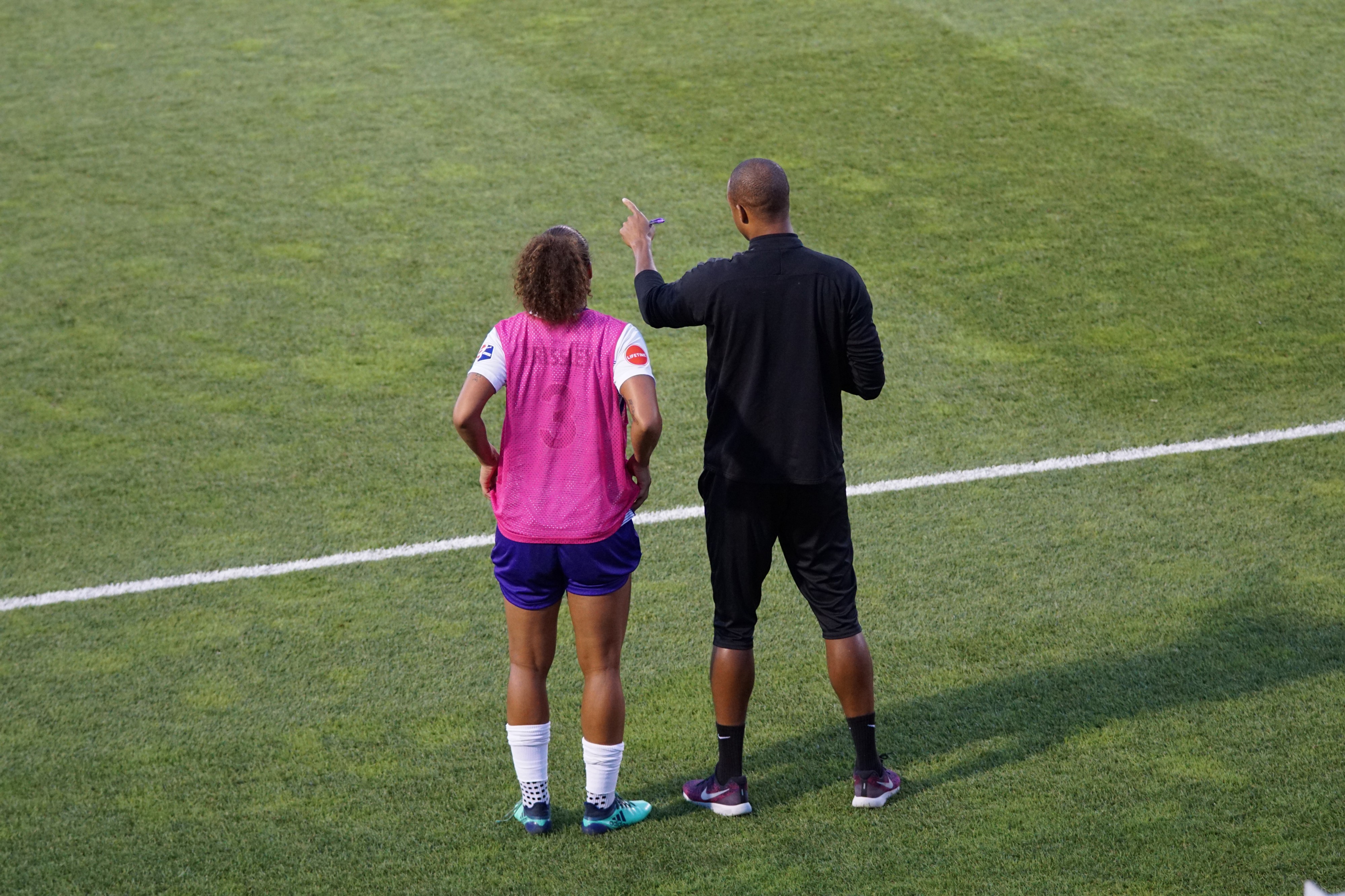
    Photo by Jeffrey Lin on Unsplash

    “The most important takeaway from the research is that the shorter the time interval between eliciting the evidence and using it to improve instruction, the bigger the likely impact on learning … the biggest impact happens with ‘short-cycle’ formative assessment, which takes place not every six to ten weeks but every six to ten minutes, or even every six to ten seconds.”

    — from Embedding Formative Assessment, by Dylan Wiliam and Siobhan Leahy

    Think about that quote. The shorter the time interval, the bigger the impact on learning.

    Let that sink in for a bit.

    Nineteen years into teaching, I still don’t have the assessment game completely figured out. No matter how much feedback and assessment I provide, I labor under the constant burden of all the other student work that I feel I should be assessing.

    In the evenings, on my weekends, on holidays, and even on snow days — especially snow days — I hear that quiet voice.

    You should be grading work right now.

    However subtle, it’s constant guilt and pressure. You know the feeling.

    It’s enough to drive teachers insane. Studies confirm that it’s even enough to drive some from the profession entirely.

    Image Credit: Sam Hames on Flickr.com

    I started my career in the pre-internet classroom. In my 7th and 8th grade classrooms, I always had at least one tray marked INBOX. Work from learning activities given throughout the day generally ended up there. (Many of them with no names — remember that fun?)

    Depending on the day’s activities, I might have anywhere between 25–100 sheets of paper in my inbox by day’s end.

    And I would do my best to mark all those papers, of course. But inevitably the constant barrage of paper would start to pull away. My chunk of papers would become a pile, then a stack, then a mountain.

    Within a month or two, my school bag was ballooning out of control. And I wasn’t alone. I remember colleagues who resorted to milk crates to ferry their paper mountain back and forth from home each day. Milk crates, filled to the brim with assignments that required marking.

    Just take a moment to savor that accumulation of anxiety. Ahhhhhhh.

    I’ve taught just about every subject in middle school, and I can tell you without a shadow of doubt that the most challenging assessments to complete — at least, in the traditional sense — were the writing pieces in English class.

    Combing through a middle school student’s piece of writing was a brutally exhausting endeavor — especially before computers in the classroom. Traditionally, I was looking for form, style, meaning, and conventions. But I wasn’t just evaluating — I was coaching — and so I sought to offer meaningful feedback and notes as well.

    Make sure your subject and verbs agree.”

    “Fortnite should be capitalized — proper noun”

    “New paragraph here”

    The math on this kind of feedback got ugly. To carefully comb through one piece of average writing and offer this level of feedback could take three or more minutes. With 28 students in my class, that was about 90 minutes of marking. Then the feedback had to be recorded — first in a place and way the student could observe it, then in my gradebook or assessment tracker.

    Add any time to take breaks, talk to family and friends, or just generally be human, and we’re talking two hours.

    Two hours of marking — typically in an evening when I felt exhausted from the day. For one learning activity.

    And of course that didn’t count time spent on unit plans, lesson plans, email, parent communication, coaching, etc.

    It was too much time.

    The bad news about the scenario I just described is that it often failed to yield the results I was looking for. Even if I returned those assignments the very next day, it was unlikely that most students would pay much attention.

    To put it bluntly, I could spend five minutes marking one piece of writing only to have the student look at it for five seconds.

    And realistically, my timeline on returned writing assignments was decidedly not next day. A week or two, maybe.

    Of course by that time, students really didn’t care. Well, they might care briefly about the grade. But it would definitely be a minority of students that would look much further at that point.

    So what, exactly, was being learned through this assessment process? Very little, I suspect.

    In fact, I knew it was very little, because my writers would tend to make the same mistakes all year long.

    In the last three years especially, my thinking on assessment has started to change in big ways.

    For one thing, this is only my second year in nineteen years of teaching that my gradebook contains no numbers. I’ve gone gradeless. By itself, that’s a massive change in mindset with a ton of implications.

    For one thing, I no longer regard marks as currency. In older models of education, students and teachers lived under the understanding that for every piece of work done, there ought to be a payment.

    Students (workers) completed work for their teachers (bosses) and were paid grades (wages) for their efforts. Every piece of work was worthy of compensation.

    The size of the reward matched the level of compliance. The game of school.

    The problem with the game of school was that it often ignored the true business of education: the learning.

    In school and in life, people learn best in the moment. When I learned to launch a podcast, caulk my shower, or build a website, it would have done me little good to receive feedback or assessment a week or two after I attempted the task.

    I needed the help and feedback right then and there — precisely when I was engaged, prepared, willing to learn, making mistakes and finding my way.

    That’s when feedback and coaching made the biggest difference. That’s when it was powerful.

    In Hacking Assessment: 10 Ways to Go Gradeless in a Traditional Grades School, Starr Sackstein writes that “Assessment must be a conversation, a narrative that enhances students’ understanding of what they know, what they can do, and what needs further work. Perhaps even more important, they need to understand how to make improvements and how to recognize when legitimate growth has occurred.”

    And that’s where I’m at today — intensely interested in those conversations, those in-the-moment, real-time, productive struggles.

    I’m interested in helping my students wrestle with and through problems, create solutions, collaborate efficiently, and communicate effectively.

    I’m interested in helping them understand where they are, where they need to get, and the steps they need to take to get there.

    I’m interested in helping my learners assess their peers more effectively, offering feedback that is kind, specific, helpful, and accurate.

    And I’m interested in tech tools like Google Classroom, Google Docs, Seesaw, and others like them that facilitate all of these ongoing, powerful, real-time conversations of learning in new and effective ways.

    Just as it is on the sports field, my most effective coaching will never happen a day, a week, or a month after the fact. My best coaching and feedback happens right there and then in the classroom as my students study, learn, create, build, design, and share their learning.

    That’s where the action is, and that’s why I’m putting less energy into summative assessment and more energy into formative. It’s why I don’t worry about the marking mountain as much as I used to. It’s even why I can relax enough to reflect on my practice and write this blog post.

    Because the best feedback my students will ever receive happens right in the moment.
  • Episode 114 – Julianne Ross-Kleinmann


    114 - Julianne Kleinmann3.png

    Meet Julianne Ross-Kleinmann

    JULIANNE ROSS-KLEINMANN is passionate about the power of instructional technology to support teaching and learning, sharing what she’s learned with others, and community service — her focus for over 30 years as a member of Delta Sigma Theta Inc.

    Julianne formally started teaching technology in the 1990s, and she became an ISTE member soon after. She’s a frequent presenter at conferences and schools on topics including technology applications, integration and troubleshooting, rubrics and assessment, STEM, makerspaces and room design. Her favorite presentations have involved co-presenting with her students on topics relating to computational thinking using the Scratch and Scratch Jr. programming languages.

    Julianne is currently an Instructional Specialist for the Ulster County Board of Cooperative Educational Services (BOCES) in New Paltz, New York. She is an Iste Certified Educator, Apple Teacher, Certified BrainPOP Educator (CBE), Google Level I Certified Educator, ISTE Mobile Learning Network 2017 Excellence Award Winner and past chair of the ISTE STEM Professional Learning Network (PLN), and currently serves on the ISTE Board of Directors. 

    “First and foremost, I’m a teacher,” Juli says. “I’m a teacher, a learner, and a service leader. I like to help others lead toward success. For me, it’s really important that the student surpasses the teacher.”

    Fighting the Doubts

    Juli can say she’s never been “run out of town” in a professional sense, but she’s certainly left a few contexts where she felt like it was just not the right fit. She’s worked in some isolating circumstances, including those where she has been the only female, the only female of color, or the only female who was more academically centered versus IT centered, and in some of those contexts she’s been met with stiff pushback.

    Pushback and resistance can make us question ourselves, she says. We can start to feel like failures because our views are not well-received and don’t fit with the status quo. It’s in those low moments that Juli has leaned heavily on her always-supportive husband and positive professional learning network to provide the encouragement, confidence, and affirmation that she needed.

    Her Path and Passion for STEM Education

    She actually didn’t intend to become a teacher in the beginning, Juli laughs, and she wasn’t always interested in STEM or technology. But when Simon Helton asked Juli to support the Math and Science network at ISTE, she accepted. She began building professional relationships immediately and has served in this role with ISTE ever since. Today, the ISTE STEM Network provides collaboration, professional development, and support for STEM teachers and leaders around the world, and Juli has been a proud part of its ongoing development.

    STEM education is all about computational thinking, problem-solving, project-based learning, and real-world design. There are so many applications and expressions of STEM, and the list is growing all the time. Looking at the great inventions and innovations of the past gives us vision and clarity regarding directions for the future. Even a revolutionary social figure like Harriet Tubman modeled the STEM spirit through systems thinking, empathy, and proactive problem-solving.

    Diversity, Equity, and Inclusion in STEM Education

    Diversity, equity, and inclusion have become focus points for the ISTE STEM PLN. One of the ways ISTE is working towards greater equity is to promote scholarships and programs that fund minority representation in ISTE’s speakers and conference attendees. ISTE is also piloting an Equity Action Forum that gave educators a place and space to unpack big issues in this area of equity with a focus on action. And Juli has contributed to the development of another ISTE initiative called Growing ME: Bridging the equity gap through mentorship

    Other Points of Professional Passion

    One of the things that has really ignited Juli’s passion for the ISTE educator certification process is the journey of becoming a blended, reflective education leader herself. She’s also passionate about SEL in education. Perhaps it’s nothing new, but she still loves the fact that social-emotional learning is such a focus in schools today.

    Bringing Scratch and Robotics to the Mid-Hudson Valley

    One of Juli’s professional goals in 2020 is the prospect of bringing a Scratch Day event into the mid-Hudson Valley. She’s also interested in robotics comptetitions, Vex events, AI and other blended learning opportunities. She sees educators traveling great distances to take part in these sorts of events and would love to host some closer to home.

    Other Personal Passions That Bring Juli Alive 

    Ever since she was a child, Juli has enjoyed baking cakes with her mother and legendary aunt. She’s taken some baking courses and loves to watch baking shows. She’s also a big fan of motorcycle riding and looks forward to getting back on the iron horse and riding through the Hudson Valley in 2020.

    Productivity from the Professional Learning Network 

    Juli’s productivity hack is her professional colleagues and support network. “I need to surround myself with people who have gone through what I’ve gone through, people who are kind and can sympathize, and also people who have nothing to do with education and bring a fresh set of eyes to situations.” These people are like family, she says.

    Voices and Resources That Inspire Her Practice 

    Over on Twitter, Juli recommends following @ISTESTEM to connect with an uplifting group of educators passionate about STEM education.

    Asked to point to an edtech tool, Juli enthusiastically boosts Scratch and Scratch Junior, the simple but powerful coding languages developed at MIT to help younger learners build computational thinking skills.

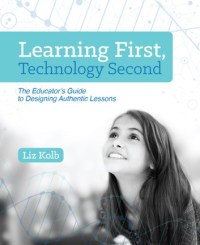
    learning-first-technology-second.jpgJuli’s book pick is Learning First, Technology Second: The Educator’s Guide to Designing Authentic Lessons by Liz Kolb, a profound look and essential starting point for educators looking to do more with technology in their classrooms.

    Based on encouragement from Jorges Valenzuela, Juli has tuned in to the STEM Everyday Podcast hosted by Chris Woods, another former guest of the show. Follow Chris and get to know his show @DailySTEM

    When she finds the time to put up her feet, Juli’s latest picks on Netflix have included Vantage Point and a modern classic, Stranger Things

    We sign off on this inspiring conversation, and Juli reminds us to connect with her on Twitter @JBR_Kleinmann.

    Connect with the Teachers on Fire podcast on social media:

    Song Track Credits

    Listen on YouTube and subscribe to the Teachers on Fire channel!

    *This page contains Amazon affiliate links.

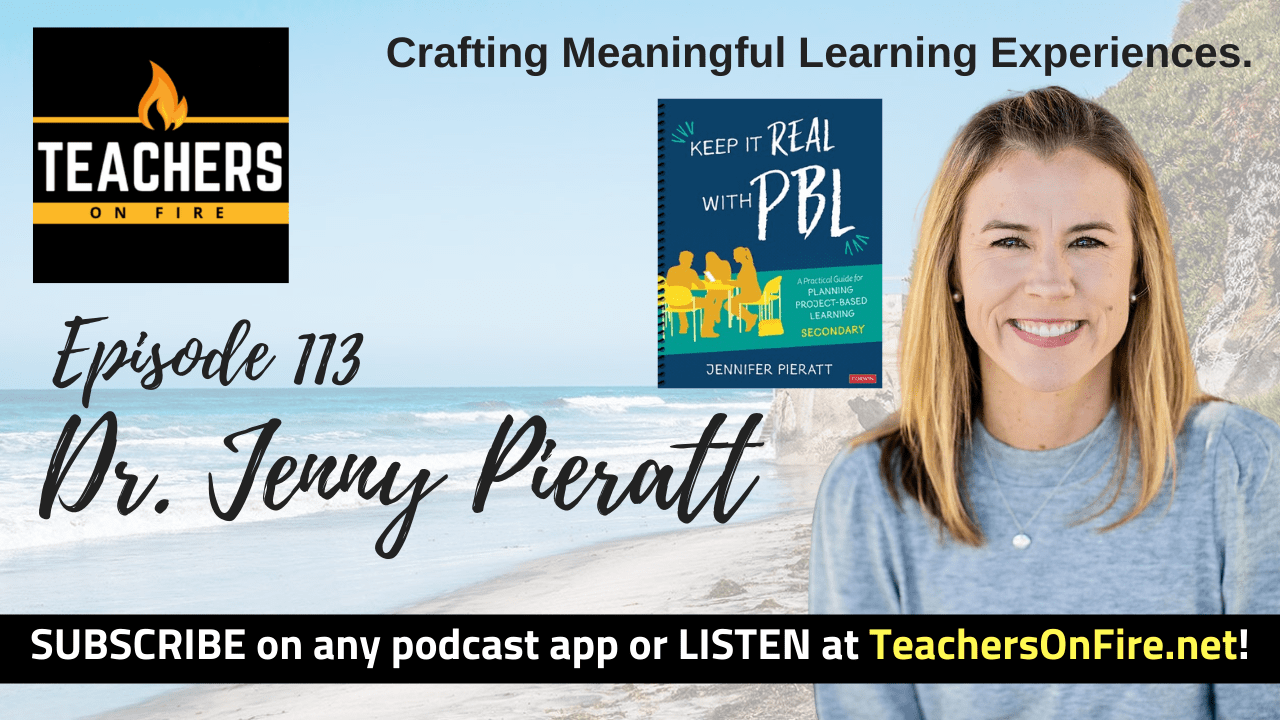
  • Episode 113 – Dr. Jennifer Pieratt


    113 - Dr. Jenny Pieratt.png

    Meet Dr. Jennifer Pieratt

    JENNIFER PIERATT is an educator, mom, speaker, coach, and project-based learning nerd. She offers tips, tools, and inspiration for Project-Based Learning and is the author of three books, including Keep It Real With PBL, Secondary: A Practical Guide for Planning Project-Based Learning. She hails from a small California beach community called Cardiff-by-the-Sea.

    Mad Respect for Primary Teachers

    Jenny had been teaching for about eleven years before she decided to pivot her career and work for two companies that support project-based learning implementation across America. It was incredible work: she learned so much, saw so many school environments, and built a ton of amazing professional relationships.

    After three years of this work, she decided to change course again. She had small children at home, and all her time on the road was putting a strain on her family. She returned to the classroom, thinking that teaching fifth grade would be a breeze, but was instead surprised to find it a steep challenge. Used to teaching secondary, the move to the primary classroom was a bit of a shock, and she calls it the hardest thing she has ever done.

    Today, she says she has mad respect for primary teachers who work with kids all day, for every subject, often without breaks. She calls this part of her teaching journey the impetus for the work that she does today and credits her discouragement for adding perspective and insight into the challenges that middle school teachers face.

    Keep it Real with PBL

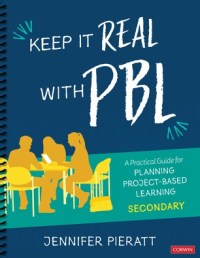
    Keep it Real with PBLIn January 2020, Jenny will publish Keep It Real With PBL, Secondary: A Practical Guide for Planning Project-Based Learning from Corwin Teaching Essentials. Jenny intended the book to be a go-to resource for teachers who are venturing into PBL – an organized and accessible source of support that she could leave behind with teachers who hoped to maintain the momentum and learning derived from her training workshops. The book is designed for continuous reference and growth, something teachers can refer back to time and time again.

    Jenny also offers a series of online courses and coaching opportunities around project-based learning. With work experiences at PBL Works, High Tech High, and New Tech Network, she feels that her philosophy and application of PBL integrates the best flavors of all three organizations. She’s not averse to going rogue or off-script in a workshop, she says, because sometimes educators become overwhelmed by the scale of the work involved. Clarity is essential.

    A Favorite Project Idea

    One of Jenny’s all-time favorite projects is called Silent Voices and it comes from a school called Lake Elementary in Vista, California. It starts by looking at the American Revolution from the eyes of marginalized groups in history and then moves to compare the state of those groups to the challenges faced by marginalized groups in today’s society. It’s a very layered project that demands critical thinking and substantial depth of knowledge, and the end products created by these fifth graders never cease to impress.

    Something Setting Jenny on 🔥 in Education: Technology

    Technology in the classroom can be a tremendous asset, Jenny says, especially when it is used in ways that enhance project-based learning. She applauds the schools that are using technology to engage their communities, showcase their learning in online exhibitions, collect data, bring experts into the classroom, or conduct field work instead of traditional field trips. She’s seen some classes at the elementary level – even kindergarteners – who are leaving the classroom to collect their own data in the field. How exciting and authentic is that?

    A Professional Goal for 2020

    Jenny has been giving her 2020 resolutions some thought lately, and one big focus will be a commitment to collect, highlight, and showcase more Math and world language resources for PBL. These subjects often feel like the forgotten children, she says, which only increases her desire to inspire educators in these important categories.

    Personal Passions: Exercise and Nutrition

    Jenny describes herself as a very active person, and laughs that she is not her best self unless she’s gotten her workout in for the day. She thinks it’s important to try a variety of fitness activities, and some of her experiments have included triathlons, boxing, and hip hop dancing. She’s also interested in nutrition, and with a sister who’s a registered dietician, it’s easy to remain a curious (hungry?) learner in this area. 

    A Key to Productivity: Her Happy Planner

    One of the biggest keys to her productivity is her Happy Planner, Jenny says. She blocks her time by hour for every day in this notebook, and it generally results in a pretty regimented but productive day. To make sure a task is completed, it needs to appear in her planner – otherwise, it just gets lost in the shuffle.

    Voices and Resources That Inspire Her Practice

    Over on Twitter, Jenny recommends following Camille Nunnenkamp @MissNunnenkamp, a fifth grade teacher at Lake Elementary in Oceanside, California, part of the Vista Unified School District. Camille is doing some awesome things with PBL in her practice, and she posts accessible examples of what PBL can look like in the middle years. For anyone looking to grow their PBL skill set, Camille is a must-follow.

    Jenny’s pick for an edtech tool has to go to Evernote, a tool that makes tracking, syncing across devices, and collaboration as effortless and efficient as possible.

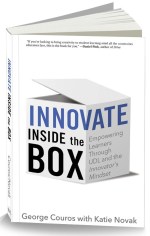
    Innovate Inside the Box by George Couros and Katie NovakOne book Jenny has been enjoying lately is Innovate Inside the Box: Empowering Learners Through UDL and the Innovator’s Mindset by George Couros and Katie Novak. She gained a ton from George’s first book, The Innovator’s Mindset,  but finds this title even more applicable to the context of project-based learning.

    Two podcasts that Jenny thoroughly enjoys include the legendary Serial, a true crime classic in the podcast space, and a newer show, To Live and Die in LA.

    When the day is over or the weekend is upon her, Jenny is watching The Crown on Netflix. The series chronicles the life and career of the Queen of England, and to anyone with an interest in history, this is must-watch material.

    We sign off on this fantastic conversation, and Jenny gives us the best ways to connect with her online. See below for details!

    You can connect with Jenny …

    Connect with the Teachers on Fire podcast on social media:

    Song Track Credits

    Listen on YouTube and subscribe to the Teachers on Fire channel!

  • Episode 112 – Daniel Bauer


    112 - Daniel Bauer.png

    Meet Daniel Bauer

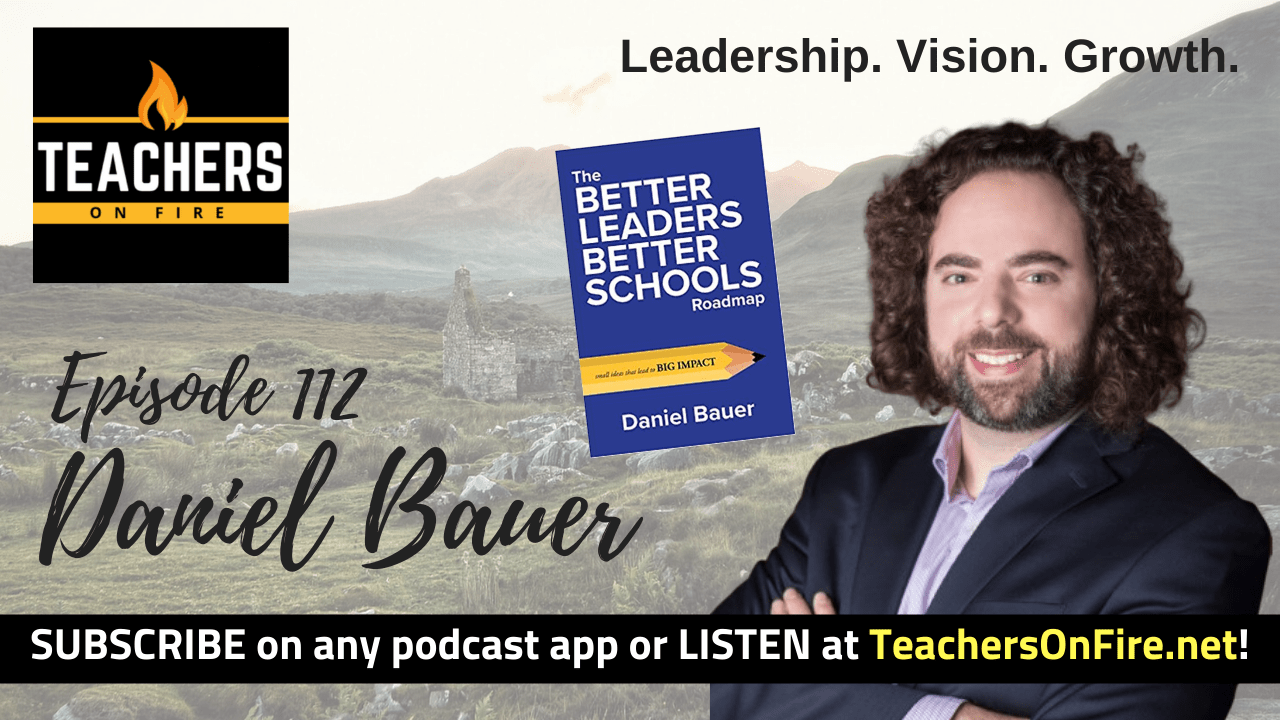
    DANIEL BAUER is on a mission to unlock the potential of global school leaders. He’s an international speaker, the host of the Better Leaders Better Schools Podcast, and the author of The Better Leaders Better Schools Roadmap: Small Ideas that Lead to Big Impact, published in 2018. He supports school leaders in individual and group contexts, and when he’s not coaching, he’s creating content or reading in order to further develop his skill set and bring even more value to the leaders who seek his mentorship.

    A Leader in Conflict

    Danny is currently working with a school principal who is experiencing significant adversity. Still new at her position, she was hired to bring about changes to a learning community, but reactions to some of her first moves have not been positive at all. Instead, her decisions have been met with strong resistance from staff members, and district central office is not offering support. The conflict has even been reported in the media, and this leader is struggling to salvage positive outcomes from a seemingly toxic situation. The writing seems to be on the wall in terms of where this is headed.

    When it comes to problematic situations like this one, Danny says, it really isn’t about assigning values of good or bad to the conflict. It’s about learning from the challenges and responding in strategic ways that align well with our personal values.

    The Mission of Better Leaders, Better Schools

    Better Leaders Better Schools by Daniel BauerIn The Better Leaders Better Schools Roadmap: Small Ideas that Lead to Big Impact, Daniel spends the first two thirds of the book describing what inner journeys of personal and professional transformation can look like. In the final third of the book that he gets into the tactics and challenge-setting that mimics his coaching and mentorship.

    As we dig deep into our own journeys, we often come to find that we are caught up in limiting activities that don’t contribute to our Great Story, the vision we hold for the impact we want to make. To achieve the things we want to achieve, we need to first clarify our key priorities and then make sure the game is fun and winnable.

    Shallow Work vs. Deep Work

    When asked for an example of an activity that educational leaders often spend too much time and energy on, Danny points to email. When you look at the effort invested in crafting and drafting emails, the returns on investment are simply not justifiable, he says. Too often, carefully crafted emails are either ignored or fail to deliver the impact to stakeholders that leaders seek.

    Yes, leaders must spend time on these platforms, and they must communicate effectively with their communities, but Danny makes a distinction between two levels of work. Shallow work doesn’t result in big wins – it simply allows one to maintain the status quo and keep their job. It’s the deep work that makes legends, produces organizational wins, inspires tribes, and creates meaningful change.

    Why We Need to Tell Good Stories

    A recent guest on the Better Leaders Better Schools Podcast that Danny found especially inspiring was Jared Horvath, author of Stop Talking, Start Influencing: 12 Insights From Brain Science to Make Your Message Stick. Horvath writes and speaks about how the brain operates and how content creators can package their messages in ways that resonate with their audiences. People respond to stories, and whatever or wherever we communicate, we must invite the listener to make an emotional connection with our message. 

    Whether you’re a leader in a business, a school, or a classroom, people are going to tell a story about their experience of working with you. What do we want that story to be? Education and certification has little to do with the story – instead, it’s really about how we make people feel.

    Simon Sinek talks about the Golden Circle and the importance of starting with our WHY. The WHY for Better Leaders Better Schools is that everybody wins when a leader gets better. At the end of the day, that’s really what it’s all about: every stakeholder winning

    What Else is Setting Danny on 🔥 in Education Today: Vision

    Danny is thrilled when education leaders create unique and compelling visions for the future of their learning communities. Ignore the education buzzwords that have saturated the majority of schools, Danny advises, and craft something that is different. Seth Godin calls this a purple cow – something remarkable, something unique, something that inspires.

    His own Vivid Vision is eight pages long, Danny says, and it reminds him exactly where he intends to go and what he plans to achieve over the next three years. When we write our vision down and publish it, we add the leverage of public accountability. With that accountability comes increased focus and intensity, and we tend to achieve exactly what it is we project.

    Deep Work by Cal Newport.jpgIn Deep Work: Rules for Focused Success in a Distracted World, author Cal Newport writes about Bollingen Tower, a physical retreat center that psychologist Carl Jung built as a place to focus and do great work. Danny is building on Jung’s ideal of physical separation to offer a two-day vision-casting retreat in the summer of 2020. Set in New Mexico and held on July 9-11, 2020, the purpose of this time is to help leaders recharge, build relationships, and clarify their own Vivid Vision for the next three years.

    Professional Development: The 10% Rule

    Danny is a strong believer in personal and professional development, and he makes it a policy to invest 10% of his income to those ends each year. In February, he completed Seth Godin’s AltMBA, something he calls a profound, life-changing event. He took a course in finding mastery, an exploration of how to live and execute at your personal best, and a storytelling seminar also put on by Seth Godin. He’s also currently plugged into courses on public speaking, coaching, and mindset.

    “I can’t help others develop personally or in terms of their leadership if I’m not doing it myself,” he observes. He recognizes that not everyone can afford to invest 10% of their income in personal development, but he also thinks it’s worth asking the question of “What is the cost of not investing in yourself?”

    A Personal Passion: Mountain Climbing

    Annotation 2019-12-13 104109.pngSomething that has been invigorating Danny lately is the practice of climbing mountains in Scotland, his current location. It’s an activity that yields obvious physical benefits, disconnects him from screens, boosts his mental clarity, and renews his perspective. It’s a generous gift to be reminded of just how small we are and be humbled by the vastness of the nature that surrounds us, he says. He’s done some hiking in the US, particularly Colorado, but the experiences of hiking in Scotland have been thoroughly enjoyable and he looks forward to more.

    Personal Productivity: Identify Your OKRs

    Measure What Matters by John DoerrWhen it comes to personal productivity, Danny points to a book called Measure What Matters: How Google, Bono, and the Gates Foundation Rock the World with OKRs, a title from John Doerr. In it, Doerr writes about phenomenal leaders who understand how to leverage OKRs – objectives and key results.

    It starts with identifying your objectives, those big ambitious goals that you don’t even think you can achieve, Danny says. From there, it’s about quantifying the key results that help you work towards the realization of those grand objectives. For more on OKRs and the ways that school leaders can leverage them, check out Danny’s in-depth blog post.

    Right now, Danny lives by five big objectives: He wants to …

    1. Help more school leaders level up,
    2. Create amazing content,
    3. Increase his brand awareness,
    4. Launch a live event, and
    5. Improve his personal fitness.

    He allows these five big rocks to guide all of his decisions in terms of where to invest his energy, time, and resources, and he makes it his goal to chip away at each rock a little more each day. The Japanese have a proverb that vision without implementation is merely a daydream, and in Measure What Matters, author John Doerr writes that ideas are easy – execution is everything.

    Define your OKRs, Danny says, and then take action to move the needle on at least one of those objectives each day. In addition, he urges, make those objectives public in order to raise your support and accountability. Tell your partner, your teammates, your colleagues, and your PLN about your objectives, because isolation is the number one enemy of excellence.

    A question Danny asks in his leadership mastermind group is “What is your one big thing?” From there, Mastermind members hold each other to account. Are your words and deeds aligning with your stated objectives?

    Voices and Resources That Inspire His Practice

    Over on Twitter, Danny recommends following Aubrey Patterson @PattersonAubrey. Aubrey is building an education consultancy called Nohea Kindred, and his message is ‘Simply. Amplify. Clarify.’ He’s doing a great job of achieving just that, says Danny.

    In keeping with his earlier comments about limiting the time we spend in our email inbox, Danny recommends a digital tool called SaneBox. SaneBox uses AI technology to help you streamline your inbox, block unwanted marketing and promotions, and give you helpful prompts and reminders.

    The Art of PossibilityA book that he calls personally transformative is The Art of Possibility: Transforming Professional and Personal Life by Rosamund Stone Zander and her husband, Benjamin Zander. The Zanders describe twelve life practices that redefine what is possible in our personal and professional lives, and Danny was so taken with their principles that he named his company The Twelve Practices. 

    Danny swings from audiobooks to podcast binges, and when he’s in podcast mode, two of his favorites are Akimbo: A Podcast from Seth Godin and The Knowledge Project by Shane Parrish

    A YouTube channel that keeps things light and adds necessary levity to Danny’s life is The Late Show with Stephen Colbert. And when he’s at the end of his day with no energy left for the five big objectives, Danny has been tuning into Watchmen on Amazon Prime, a series that follows what some call the greatest comic series ever written.

    We sign off on this fantastic conversation, and Danny gives us the best ways to reach out and connect with him online. See below for details!

    You can connect with Daniel Bauer …

    Connect with the Teachers on Fire podcast on social media:

    Song Track Credits

    Listen on YouTube and subscribe to the Teachers on Fire channel!

  • Episode 111 – Abigail French


    111 - Abigail French.png

    Meet Abigail French

    ABIGAIL FRENCH is a mother of four, a history teacher for sixth graders, an advocate of public education, and an explorer of the natural world in Woodstock, VA. 

    A Challenging Professional Reboot

    For Abby, one of her biggest professional challenges was returning to the classroom in 2014 after leaving it in 1997. A lot had changed while she was away, particularly technology resources and internet access. She recognized immediately that technology should be used to build skills, facilitate learning, and create deeper understanding, but it took some time to adjust to the changes that technology had brought to the learning environment.

    Today, her sixth graders enjoy 1:1 Chromebook access, a move that has come with a mix of tremendous opportunities and practical challenges. “It’s definitely a journey,” Abby says of her use of technology in the classroom. “It’s always evolving – it’s not like you ever arrive.” As she models a posture of constant learning and openness to new things, you sense that Abby’s learners are in good hands.

    The Snake That Rocked Edu Twitter 

    Abby has been fascinated by herpetology – the study of reptiles – for about as long as she can remember. She’s even gained such notoriety in her community for the courage, care, and prowess she shows around snakes that she is known by some as The Snake Lady!

    When her daughter called her about a large snake in the backyard in the summer, Abby didn’t hesitate to run outside and move it. It was likely a female, she says, looking for a nice place to lay her eggs. What others fear, Abby loves to engage and learn from.

    Not Measuring Up

    Abby isn’t someone who went into teaching because she had such a great experience as a student. In some ways, she actually went into teaching to undo the damage done and to give students a better learning experience than the one she remembers.

    As a young student, Abby is quick to point out that she definitely had some good teachers. But she had a learning disability, a processing issue, and that meant that she learned differently than most other kids. The symptoms of academic success, including good grades, words of affirmation, and the approval of her teachers always felt elusive. She still clearly remembers the feelings of falling short, of never being good enough, of never quite fitting into the game of school. Those memories and experiences have shaped her philosophy and professional practice profoundly.  

    Rethinking Assessment in Her Practice Today

    As with technology, Abby’s approach to assessment has been a journey. It starts with a mindset, she says. As she returned to teaching five years ago, she realized that traditional means of assessment – quizzes, tests, and multiple choice assessments – were not satisfying her desire to know what her students actually knew and had learned.

    She started looking around at other examples and modes of assessment, asking how she could better partner with her students and include them in every part of the assessment process. She wanted to put students in the driver’s seat: how do YOU want to show what you’ve learned? Building strong relationships with students was an essential step toward empowerment, she observed. Student reactions to her change in philosophy have been exciting, and Abby is constantly learning about the ways to represent learning that energize her students and connect with their passions and interests.

    One other way that Abby has started changing her practice is to change the way that she organizes her students’ digital portfolios. Rather than organize them by subjects and units, she has started to organize them around learning targets and skills: analyze and interpret, compare and contrast, using a decision-making model, etc. This means of portfolio organization shifts the focus from the content to the skills: what are we actually trying to learn? Which skill does this work demonstrate?

    #HackLearning: Countering Toxic Cultures 

    Abby recently moderated a #HackLearning Twitter chat about toxicity in schools, and she’s given this topic a lot of thought lately. It’s a challenging topic with a ton of complexity and layers, and she’s quick to point out that there are no quick fixes or easy solutions.

    Teachers pour themselves into their work, and the emotional well can get pretty low if communities aren’t doing the important work of caring for their members. The work of teaching becomes doubly difficult in environments of toxic thinking and behavior, but one thing we should always keep in mind is that toxicity is rarely personal. Instead, it usually appears as a symptom of what someone else is going through.

    Ultimately, we need to protect our own mindsets by finding supportive partners, both locally and through our professional learning networks. PLNs such as the education community on Twitter can deliver incredible encouragement and inspiration, and it’s a great way to find your people when you’re feeling isolated or marginalized in your own learning community. Even as we connect outside the walls of our school, however, it’s important to continue to invest in our own community. 

    A Professional Goal: Instructional Coaching

    Abby has been exploring some growing opportunities in the area of instructional coaching, and lately it’s been a pleasure to serve in a mastermind group for new teachers. She’s excited to contribute, and she enjoys the growth she sees in her own practice along the way.

    Personal Passions Outside of Education 

    MushroomsOutside of school, Abby enjoys sharing passions with her four children. Their curiosities are endless and they stretch her into new spaces that she otherwise wouldn’t necessarily find herself. She is also energized by running, getting into nature, and hunting for mushrooms. Mushrooms fascinate her, and it’s a joy to find them, photograph them, and cook with them.

    A Personal Productivity Hack: Time Blocking

    Abby credits Aubrey Patterson with the practice of time blocking. She uses Google Calendar to prioritize her time for the week and make sure that the big rocks are accomplished before the sand. Her next mission? Getting a better handle on her Google Drive and organizing it more efficiently.

    Voices and Resources That Inspire Her Practice

    Over on Twitter, Abby recommends giving Jeanne Wolz a follow @TeacherOffDuty. Jeanne is an instructional coach who Abby has learned a lot from lately. She also recommends following Aubrey Patterson @PattersonAubrey, co-founder of Nohea Kindred, educational leadership strategist, and consultant.

    An edtech tool that has taken learning to the next level in her sixth grade classroom as of late is Zoom. Zoom has allowed her to connect with other educators in real time, bringing new insights and information into her classroom.

    Entertaining an Elephant by William McBrideAbby’s book pick comes from a book club she joined this year. The title is Entertaining an Elephant: A Novel About Learning and Letting Go by William McBride. The book chronicles the journey of a seasoned teacher who battles burnout. Follow the author on Twitter @DrBilly7

    Two podcasts that are making a difference in Abby’s professional practice are Teachers Going Gradeless and Human Restoration Project. Both shows completely reimagine education and particularly assessment, and they’ve been fuel for her professional growth and evolution.

    When she’s got no energy left in the day and it’s Netflix time, Abby is watching Peaky Blinders, a great historical series, and Jane the Virgin, a source of non-stop laughs.

    We sign off on this great conversation, and Abby gives the best ways to connect with her online. See below for details!

    You can connect with Abby on Twitter @AWFrench1. 

    Connect with the Teachers on Fire podcast on social media:

    Song Track Credits

    Listen on YouTube and subscribe to the Teachers on Fire channel!