• Episode 71 – Rose Pillay


    71 - Rose Pillay

    Meet Our Guest

    ROSE PILLAY is an education leader and curriculum consultant for the Catholic Independent Schools of the Vancouver Archdiocese. Her One Word for 2019 is SMILE, and Rose keeps educators inspired on her mission to serve, support, and celebrate growth and relationships. She sees her roles as 1) professional learner, 2) good news gossip, and 3) educational matchmaker.

    Buckle up for this interview! Her colleagues call her a girl on fire, and you’ll understand why when you hear her passion and commitment for learning. Follow Rose on Twitter @RosePillay1 and visit her blog at https://teachafl.wordpress.com/.

    Everything We Do in Teaching is Relational

    There are days when Rose has felt she isn’t making a difference. Imposter syndrome creeps in, and she the doubts can be debilitating.

    To counter these feelings of inadequacy and negativity, Rose makes a conscious choice to curate and keep any and all the cards, comments, and collectibles that are affirming and empowering. She also designates a label in her inbox simply marked Sunshine, and it’s filled with messages that empower and bless her.

    To further bolster her confidence, Rose is proactive about surrounding herself with people who not only cheer her on but challenge her to be better. “Everything we do in teaching is relational,” she says. We need to find others who will fuel our passion.

    Faith and Learning

    As a committed Catholic, Rose feels called to bring the light of Jesus into this world, and as such she strives to be a lighthouse and source of hope for others. She wants to live in such a way that people say “I want what she’s having,” not living as one seeking to be accepted but in a way that is unashamed, unapologetic, and authentic.

    She enjoys partnering with educators from all corners and backgrounds because we all want the same things for children: to equip them to live well in an ever-changing world. She is relentless in her pursuit of the good, true, and beautiful in an effort to make our students into saints. Education has shifted its focus from transmission of information to transformation, from products to people. We’re trying to define the very best qualities of what it means to be human, to contribute to this world and make it a better place.

    Why Network on Twitter?

    For Rose, Twitter serves two main purposes:

    1. it builds professional relationships, and
    2. it creates access to classrooms, innovative practices, and inspirational conversations.

    Twitter isn’t the all-important platform, but the key is to find something, someone, or some place that recharges your batteries so that you have the ideas and energy to give back to your learners.

    Fail Better

    Rose’s blog, Fail Better, began as a reservoir of resources for educators looking to do more with assessment for learning. In June 2012, Rose wrote a post called Fail Better, inspired by a quote by Samuel Beckett: “Ever tried. Ever failed. No matter. Try Again. Fail again. Fail better.”

    From that time forward, Rose decided to use her blog to reflect on her own learning journey. Dylan Wiliam says that every educator needs to accept two commitments.

    1. Every single teacher will carry on improvement in their practice, and
    2. Focus on the things that make the most difference to students. Embrace the idea that the job of teaching is so difficult that we never really get good at it. We fail every day, but every day following we can come back and fail better.

    To fuel and direct her learning journey, Rose asks herself those Big Three metacognitive questions each week:

    1. What am I learning?
    2. Where am I going?
    3. How will I get there?

    As Richard Wagamese writes, “Don’t just write what you know. Write what you wish to know.” Storytelling is about discovery of one’s self, a way for writers to document their growth and evolution.

    New Competency-Based Curriculum for BC

    One thing that really ignites Rose today is BC’s new competency-based curriculum. It’s infused schools across the province with fresh energy, vision, and joy. The focus is where it should be – on ALL students learning and growing, from wherever they are on their journey. It’s about students finding themselves, developing holistically, and answering the most important question they will ever answer: Who am I?

    Rose is also thrilled by the new Career Life education program coming to BC’s high school curriculum – “the sun around which all the other courses will orbit.” Among other things, this new initiative is sure to challenge long-held assumptions and ways of doing in terms of high school timetables and course structures.

    A third thing that energizes Rose is the cross-pollination of ideas, resources, and practices happening between districts in British Columbia.

    A Professional Goal for 2019

    This year, Rose would like to grow as a confident, competent, and creative workshop presenter. This will mean attending more professional development events led by people who are pushing themselves, including an upcoming CAFLN conference in Delta, BC.

    Learning is a Life Passion

    Rose is a fan of learning, whatever it is and wherever it’s available. She loves to rub shoulders with other learners who attend events by choice – she calls these campfires. Being with other educators who are there because they want to learn and love community is so energizing.

    It’s the sharing of stories that really helps us grow, and for that reason Rose and her brother Gabriel are passionate organizers of an annual event called EdVent. It’s a place for educators to come and share their stories of learning and innovative practice. Teaching and learning have to be team sports! We need teammates to learn beside.

    A Productivity Hack: Saying YES More

    Inspired by Catherine Mulskey’s Ted-X Talk, The Courage to Say No, Rose is learning to actually say YES to more things, including this podcast. Saying no sometimes means that we’re not growing, and we miss out on learning. Right now, she’s focused on saying yes more often.

    “My need to KNOW things trumps my need to say NO to things,” Rose says. “For me to be successful in what I do, I want to model what it means to learn, to grow, to stretch, to take risks.”

    Voices & Resources That Inspire Rose’s Professional Practice

    On Twitter, Rose recommends following @Vendram1n. He’s a continual source of leadership and inspiration, and he’s one of the kindest and most generous leaders in education you’ll ever meet.

    Rose’s book pick is Embers: One Ojibway’s Meditations by Richard Wagamese. It’s a breathtaking work of life and beauty from an indigenous perspective.

    If you’re looking for another education podcast to add to your line-up, check out The Catholic Teacher Podcast. Follow the host @BeingCatholic1.

    Over on YouTube, Rose suggests subscribing to Five Moore Minutes by a leading voice on inclusion in education, Shelley Moore.

    Although Rose isn’t on Netflix, some of her current viewing includes This is Us and Doctor Who.

    Connect with Rose

    We sign off on this amazing conversation, and Rose reminds us of the best ways to connect with her and learn together online. Make sure to give her a follow on Twitter and subscribe to her blog!

    Subscribe to the Teachers on Fire podcast on your mobile device.

    iTunes | Google Podcasts | Spotify

    Follow the Teachers on Fire podcast on social media.

    Song Track Credits

    Listen on YouTube and subscribe to the Teachers on Fire channel.

  • My #OneWord2019: Create

    This will be a year for new content. New learning. New relationships.

    @MisterCavey on Instagram

    It was in the final weeks of December that I started to see the #OneWord and #OneWord2019 hashtags pop up on Twitter.

    I was unimpressed at first, but as some of my favorite edustars (like Rose Pillay) started to reflect on their #OneWord2019, I decided to take a closer look.

    It looks like the One Word idea has been around for a while. Although you’ll find One Word resources all over the web, the philosophy behind the movement seems best developed in a book called One Word That Will Change Your Life by Jon Gordon and Dan Britton.

    Without reading the book, my take on #OneWord is simple. Choose a word that best frames your hopes, goals, and expectations for the year ahead. Choose a word that anchors you, clarifies your mission, and reminds you of your purpose. Choose a word that you can use to connect your growth and learning as the year unfolds.

    It took me most of the last week of December, but I finally found my own #OneWord2019.

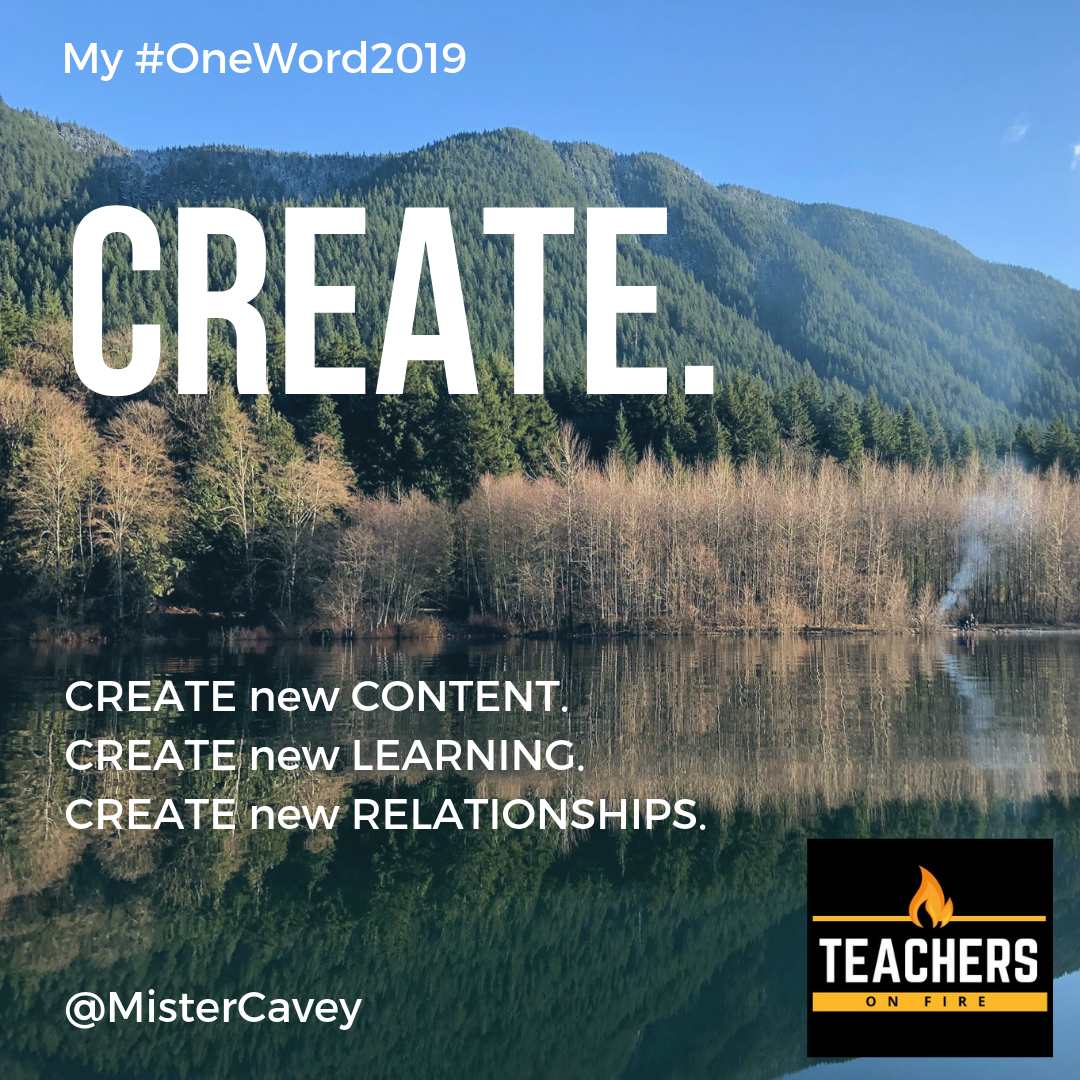
    CREATE.

    I want to see creation unfold in three dimensions this year.

    1. Create new content.

    In the last two years I’ve become a committed content creator, a journey that would take a different post to fully describe and unpack. But in general, create > consume has become a mantra that I preach and model consistently.

    Of course my biggest step along these lines in 2018 was to begin the Teachers on Fire podcast. The show was and continues to be the realization of a personal dream, and I can’t begin to explain all the ways I’ve grown and learned as a direct result of my work there. When educators around the globe share their appreciation for the podcast, it’s a tremendous encouragement. It gives my work meaning and reinforces my commitment to it.

    I also started writing more in 2018, but that’s an area where I’d really like to turn up the heat in 2019. In 2018, I wrote about 30 posts in total. Today, my goal is to publish two blog posts per week: one personal and one professional.

    There are many reasons behind this push for greater consistency, another important concept deserving of its own post. But for now, this is what I’m committing to. Two posts per week.

    I have one more piece of content in mind here that I hesitate to put on the record, but maybe the power of public accountability will be the boost I need to make it happen consistently. YouTube. I’d like to start creating content there on a weekly basis as well. Stay tuned!

    One more thing. It’s also a goal of mine to complete my Master’s thesis this year. That’s another form of content — not the kind that will be visible to most, but a pretty important byproduct of two years of academic study.

    2. Create new learning.

    I want to give my students new learning experiences this year. In particular, I want them to create, design, revise, and create products they have never created before.

    I want to create the sorts of learning experiences that will challenge them, require critical thinking, and demand new sets of skills. That’s the kind of teaching that I get excited about.

    In my own life, one way to for me to experience new learning is to read more books than ever before. According to my Goodreads account, I finished 10 books in 2018. In 2019, my goal is 15.

    I know I can hit 15 books simply by reading my Kindle before bed every night. I generally try to read 5% of a book (or books) in my account before lights out. Doing that will push me through the equivalent of a full book every 20 days this year. So that’s the plan.

    As I mentioned, my MEdL thesis studies will require more academic and field research in the areas of podcasting and professional development. That’s not only new content — it’s new learning, as well. That’s learning to look forward to.

    In general, I want to improve my attitude toward learning this year. That means adopting a stronger growth mindset, taking more risks, learning new skills, and stretching myself into uncomfortable spaces in order to experience personal and professional growth.

    3. Create new relationships.

    One of the unexpected side benefits of starting the Teachers on Fire podcast last year was the formation of so many new friendships with other educators. It’s an amazing feeling to receive support and encouragement from principals in California, teachers in the UK, and authors in Wisconsin. It’s a PLN at its best.

    In the fall of 2018 I also took a teaching position at a new school, and in many ways this community is still new to me. I’ve already built meaningful friendships here, but there’s plenty of room for deeper connection. New relationships are waiting to be formed, deeper roots to be planted.

    On a personal and completely different note, my wife and I would also love to have a baby this year! We’ve been trying for some time now, and I back and forth between going all in on hope and expectant prayer versus the pragmatism of emotional management. But there you have it — I’d also love to (pro)create a little Cavey this year. That one is in God’s hands.

    My #OneWord2019: Create

    I can’t wait to create: new content, new learning, and new relationships. 2019 is going to be an amazing year, and I look forward to learning from you along the way.

    Why don’t you join me. And CREATE.

    @TimCavey on Instagram

    by Tim Cavey, MS Teacher in Surrey, BC, Canada and host of the Teachers on Fire podcast.

  • Episode 70 – AJ Juliani


    70 - AJ Juliani

    Meet Our Guest

    AJ JULIANI is a dad, a sought-after speaker, and prolific author of several education books, including The PBL Playbook, Empower and Launch. He is a recognized authority on design thinking, genius hour, growth mindset, IBL, PBL, and all things innovation in education. Read more from AJ at http://ajjuliani.com/ and follow him on Twitter @AJJuliani.

    AJ is currently the Director of Learning and Innovation for Centennial School District, located near Philadelphia. He and his team serve about 6,000 learners. In addition to his work there, AJ writes frequently on education and speaks at schools and districts across the country.

    Frustrated by the Game of School

    Teaching in 2011, AJ was starting to get discouraged by the climate of his classes. His students were intent on playing the game of school, navigating their way through assignments in ways that they thought would earn them the best grades for the least work. Frustrated by what he saw, AJ started reading more widely and searching for better solutions in his practice.

    He eventually found Daniel Pink’s book, Drive, and it led him down the rabbit hole of intrinsic motivation, inquiry and passion-based learning, genius hour, and much more. It was the beginning of a huge paradigm shift, and he’s never been the same. He now sees student choice as a sort of secret sauce when it comes to inspiring student engagement and empowerment.

    Thoughts on How to Approach Project-Based Learning

    AJ’s practical advice about project-based learning is to start small. Try to avoid massive projects that simply follow exhaustive requirement checklists, which really amount to recipe-based learning. Instead, start with small class activities that help students embrace greater amounts of control and direction in the classroom.

    Secondly, treat the project itself as a source of continual formative assessment instead of simply using it as a piece of summative assessment at the end. It’s the main course, not the dessert. Students should be able to demonstrate their evolving understanding of concepts throughout.

    The Professional Benefits of Blogging

    In many other professions and industries, it’s normal and expected for practitioners to write about their work and share it broadly. In K-12 education, this work is often left to researchers, when in fact the teachers in the trenches have important and valuable perspectives worth sharing as well.

    AJ sees three primary benefits in blogging about educational practice:

    1. It helps us reflect on and learn from our own practice.
    2. We’re sharing the highs and lows of our practice in a way that others can learn and benefit from.
    3. As we reflect and write, you start to see your profession differently. You start to see the growth that is possible as you track your evolution as a professional, engaging with other educators, and sharing other perspectives. Blogs and PLN activities can inspire us and give us the encourage.

    Be More Chef

    Most students – and many educators – approach education as cooks. We want to follow a given recipe, and follow it well, hoping to find the success and learning that the formulas promise.

    The chef’s approach is different. She takes a look at available resources and asks “What can I make with this?” And that’s AJ’s call to educators.

    As you think about your practice and even your life, ask yourself “Am I just following recipes?” AJ’s late brother was a fine example of someone committed to leaving the beaten path and writing his own recipes. Yes, there will always be economic opportunities for people who prefer to follow and be compliant. But there are far more opportunities in today’s economy for people who are go-getters, strong self-starters, creators, makers, designers, and dreamers.

    Building Empathy Through Design Thinking and Story

    Design thinking always starts with awareness of one’s surroundings. It helps learners learn to take note of the needs of others. It helps young learners to ask critical questions to better understand their context and the needs of others. These are important skills.

    Another way we can build empathy is through stories. Brain researchers tell us that the brain processes stories in a different way than it does other information – it activates more resources in order to gain a deeper appreciation for the needs of others. Telling and sharing stories is by far the best way to build empathy.

    One recent example of a design product that came from AJ’s district was the creation of reflector socks for cyclists from MIT. The students didn’t enter the design process thinking they were going to engineer a new sock design, but after getting a clearer understanding of the needs of the cyclists, that’s where they ended up. The socks continue to sell today! In another case, some elementary students designed an artificial insect that could evade exterminators effectively. These second graders had to pitch their product design to some actual exterminators – another authentic learning experience.

    Goals, Interests, and Passions

    At the moment, AJ is working with a company called Next Lesson to develop PBL lessons and units for elementary classes. These are resources that will help educators take their first steps into PBL without jumping straight into Genius Hour.

    From a larger perspective, though, the thing that is really exciting AJ about education is how many people are doing things differently. Most educators have moved past the initial stages of integrating technology in their practices, and now so many educators are thinking more deeply and differently about the learning process itself.

    AJ derives tremendous joy and fulfillment from sports, but the thing that he’s really been diving deep into lately is AI. He’s reading and watching as much as he can, and he feels like today we’re boiling the frog – things are already drastically changing around us, often in ways we don’t notice or are not aware of. For him, AI isn’t something to fear but instead something to be cognizant of and recognize.

    Voices & Resources That Inspire AJ’s Professional Practice

    On Twitter, AJ recommends following @CultofPedagogy. He learns a lot from Jennifer Gonzales and describes her as his pedagogical North Star.

    AJ just finished reading 21 Lessons for the 21st Century by Yuval Noah Harari, and considers it a fascinating read. Follow the author on Twitter @Harari_Yuval.

    AJ’s podcast pick right now is The Knowledge Project Podcast with Shane Parrish. Follow the host on Twitter @FarnamStreet.

    Over on YouTube, AJ suggests subscribing to his co-author, John Spencer. Follow John on Twitter @SpencerIdeas.

    In terms of non-educational viewing, AJ and his wife are enjoying The Americans on Amazon Prime right now. It’s making him suspect everyone around him of being a spy!

    We sign off on the conversation, and AJ gives us the very best place to connect with him and receive more of his thoughts on education: AJJuliani.com. Visit him there and subscribe!

    Other Places to Connect with AJ

    Subscribe to the Teachers on Fire podcast on your mobile device.

    iTunes | Google Podcasts | Spotify

    Follow the Teachers on Fire podcast on social media.

    Song Track Credits

    Listen on YouTube and subscribe to the Teachers on Fire channel.
  • Episode 69 – Mike Paul


    69 - Mike Paul

    Guest Profile

    MIKE PAUL is a middle school math teacher, edtech leader, Google Certified Innovator, and the co-founder of Edcamp Kentucky. Follow Mike on Twitter @mikepaul and check out his blog at https://pikemalltech.com/.

    Mike teaches at Bardstown Middle School in Bardstown, Kentucky. Bardstown has the distinction of being the bourbon capital of the world, and was also recently judged the most beautiful small town in America. Mike teaches 7th grade Mathematics and is the IT coordinator for the district, where he helps teachers integrate technology in their classrooms.

    Making the Success of Learners the Top Priority

    During his first year of teaching, Mike received an email from a principal that was hard to receive. A school in another district was experiencing success in a particular program area, but wasn’t willing to share ideas and resources out of a sense of competition. He realized from the email and the conversation that followed that not everyone is in education primarily for students; unfortunately, some are more concerned about their own success.

    This experience only heightened Mike’s resolve to work with educators who put the learning and success of kids as the top priority and are less concerned with perceptions of success. When students win, we all win!

    How Has Technology Changed the Ways We Teach and Learn Math?

    Technology and tech tools have changed the way we teach and learn about mathematics. Today, it’s less about accurate calculations and more about proper processes, habits of mind, and approaches to problems. It’s about problem-solving skills that transfer across all domains.

    What Gets Mike Excited About Education Today

    Mike is excited by the pockets of innovation that are showing up in schools across the country that are determined to be about more than just test scores. At the Google Innovator Academy, Mike focused on developments in design thinking that empower students to solve real-world problems inside and outside of the school walls.

    Mike’s OneWord, Personal Passions, and Productivity Hacks

    Mike’s #OneWord2019 is SERVE. He’s challenging himself to assist more educators and more students than ever. By orienting himself this way in his professional and personal spaces, he knows his relationships will be enriched and opportunities for growth are sure to follow.

    Mike is a big fan of self-improvement and personal development. Whether it means growing his mental, physical, or financial health — he loves to learn.

    Mike read The Miracle Morning by Hal Elrod, and it’s completely transformed his mornings. The key to transformative mornings are SAVERS: Silence, Affirmation, Vizualization, Exercise, Reading, and Scribing.

    Mike has become an early morning riser, starting his days at 4:00 a.m. No, he doesn’t manage to do all six things every single day, but on the days the SAVERS don’t happen, he can feel the difference.

    Voices & Resources That Inspire Mike’s Professional Practice

    On Twitter, Mike suggests following @DonWettrick, the innovation leader and enigmatic host of the StartEd Up Podcast.

    An edtech tool that has really caught Mike’s attention lately is Pear Deck. Find out more about how Pear Deck can amplify student voice and increase engagement by following them on Twitter @PearDeck.

    Mike’s two book recommendations are The War of Art by Steven Pressfield and The 10X Rule: The Only Difference Between Success and Failure by Grant Cardone. Follow the authors on Twitter @SPressfield and @GrantCardone.

    In podcasts, Mike suggests subscribing to The Ed Mylett Show. Find out more about Ed and what he’s all about @EdMylett.

    Mike’s pick for YouTube channels is The Passionate Few by Omar Elattar.

    On Netflix, there’s one show that convinces Mike to keep his subscription active. It’s The Office, of course!

    We sign off on the conversation, and Mike lets us know where we can follow him online. See below for details!

    Follow Mike:

    Subscribe to the Teachers on Fire podcast on your mobile device.

    iTunes | Google Podcasts | Spotify

    Follow the Teachers on Fire podcast on social media.

    Song Track Credits

    Listen on YouTube and subscribe to the Teachers on Fire channel.

  • Staying Hungry

    Before I’m an educator, I’m a learner.

    Photo credit: James Barker

    “The best teachers I know are the ones that still see themselves as works in progress and are continually looking for new ways to improve. They are learners. They are students of their profession and calling.”

    — Jarod Bormann in Professionally Driven: Empower Every Educator To Redefine PD

    At 40 years old, I’m now in my 18th year of teaching at my fourth school. With memories of being the “young guy” on campus still fresh in my memory, I now wear the label of veteran.

    Of course, those years of experience offer confidence and insight. 17 years removed from rookie, I have a clearer sense of my professional strengths and weaknesses.

    I know a whole lot more about classroom management and student behavior. I have a firmer understanding of what optimal conditions for learning look like. My thinking around assessment and learning has evolved astronomically. I’m better at setting personal boundaries and establishing self-care practices that allow me to be better in the classroom.

    But I’m keenly aware that I still have a long, LONG way to go and a whole lot more to learn.

    And I love that.

    There might have been a time early in my career when I envisioned the master teacher as an educator who had basically arrived. This was the teacher who held her students’ attention with hypnotic powers. Who oozed the sort of charisma that inspired incredible heights of work, creativity, and achievement. Whose timeless classroom management systems had been tweaked to a state of permanent perfection. Who drew from a bottomless well of instructional resources to locate a solution for every possible challenge. Who personally knew every inch of their content area and whose expertise was legendary.

    Who never made a mistake, never failed, who never felt embarrassed or frustrated.

    Today, there might be some aspects of confidence and mastery in that vision that I still strive for. But I also recognize that most of that picture of “arrival” is mere mythology.

    I now see that year-over-year consistency leads to stagnancy, that comfort breeds complacency.

    As I continue to grow as a professional, as I learn from my PLN, as I read Mindset by Carol Dweck or Professionally Driven by Jarod Bormann, I’m constantly reminded that we’re all — ALL OF US — on a continuous journey of growing, stretching, and learning.

    Even the best among us fail, miss the mark, pick ourselves up and continue to learn.

    Especially the best among us.

    I took a new teaching position this year, and in some ways, a new position means going back to square one. Hitting reset.

    It’s a chance to ignore my old assumptions and beliefs, to reimagine every moment, every class, every course, every subject. To critique my own practice. To push the limits of what is possible for every one of my learners.

    I want to push myself into uncomfortable spaces and take bigger risks.

    Because I haven’t made it. And because “making it” isn’t the goal, anyway.

    “If you haven’t failed in the classroom lately, you aren’t pushing the envelope far enough. ‘Safe’ lessons are a recipe for mediocrity at best.”

    — Dave Burgess in Teach Like a Pirate

    I’m a student of my profession.
    I’m a lifelong learner.
    And the appetite for growth is real.

    So I’m getting after it.
    I’m seeking to stretch, risk, grow, and learn.

    I’m staying hungry this year.