
• Episode 81 – Kelly Croy

    81 - Kelly Croy

    Meet Kelly Croy

    KELLY CROY is a committed husband, father of four girls, educator, speaker, Apple Distinguished Educator author of Along Came a Leader and the producer of The Wired Educator podcast.

    Follow Kelly on Twitter @KellyCroy and @WiredEducator, and visit his blog at https://wirededucator.com/.

    On Adversity and Empathy

    Kelly feels a tremendous amount of empathy for those around him, and so his lowest moments tend to be the lowest moments of others. When he sees struggles and frustrations in motion, his instinct is to get involved and try to provide solutions.

    He recalls a time when he was able to use technology to help a sick student stay connected with her classmates as she fought a serious illness. Although the health situation was difficult, he recognizes the way in which technology helped facilitate human relationship and connection for someone in need. He tries to approach other experiences of adversity with that same positive approach, looking for learning, growth, or other opportunities for new relationships that can come as a result.

    Advice to Educators Around Social Media

    Kelly’s message for educators when it comes to social media is to enjoy it (“Instagram can be a beautiful place”), leverage it for learning, but avoid falling into the comparison game.

    Today’s new educators come to the profession very comfortable and familiar with social media, and it doesn’t make sense to ask them to leave it. Instead, he helps them think about (in some cases) rebranding themselves as professionals and utilizing social media in their classrooms in order to advance learning.

    Authenticity on social media is critical: our job isn’t to emulate others so much as it is to share who we are and what we’re all about.

    The Mission of the Wired Educator Podcast

    The Wired Educator podcast is a passion project for Kelly. He considers it an art form and counts it a privilege to share, promote, and celebrate the great things that educators are doing for learners all over the world. He tries to elicit the essence and fire that makes each guest unique, and he pursues the ideas that produce the best outcomes for students.

    One of Kelly’s dearest accomplishments from the Wired Educator podcast was preserving the legacy of inspirational ideas shared by one guest who died unexpectedly in the year following his appearance on the show. He also recognizes the intimate connection that podcast hosts can build with their audience members over time. It’s a powerful medium.

    Along Came a Leader

    It was a lifelong dream for Kelly to write and publish his own book, and Along Came a Leader represents the fulfillment of that dream. The book came out of the realization that some of the education principles and values that Kelly considered common sense weren’t as widely held or understood as he thought they were.

    The book is focused on six tenets of leadership, which apply both in and out of education:

    1. attitude,
    2. wisdom,
    3. tenacity,
    4. communication,
    5. vision, and
    6. authenticity.

    Done right, these six traits create great leaders and great educators. “No one is born a leader,” Kelly points out. “You can become a leader – through practice, hard work, trial and error.”

    Content Creation for Educators

    Kelly notes that in education, 1) we get to do work we love, and 2) we’re put in a position where our creation, improvisation, design, and communication skills are continuously tested and developed. As educators and practitioners, Kelly sees it as essential that we practice what we preach: we need to remain innovators and model our creative process in front of our learners.

    As an overall philosophy of education, Kelly also observes that our highest levels of learning, rigor, relevance, depth of knowledge, and synthesis of learning are all demonstrated through creative activities. Yes, consumption of materials and information is an essential part of the learning process. But it’s in the project-based learning and creative projects that students truly demonstrate the application and transfer of knowledge and skills in meaningful ways.

    As an Apple Distinguished Educator, Kelly also points out that Apple is supporting a tremendous campaign and curriculum called Everyone Can Create, which puts powerful resources in the hands of educators and students that empower the creative process.

    The 1:1 Debate: Chromebooks vs. iPads

    Kelly discussed an article from the Wired Educator called The Greatest Chromebook is an iPad, where he sought to help people understand that iPads contain a lot of the same features that Chromebooks do. When one considers cost, capability, convenience, and creative applications, Kelly believes the iPad may offer better value than the typical Chromebook.

    That said, he’s also quick to point out that the key outcome is the learning that happens in the course of the creating – and that trumps brand or device. When collaborating and creating activities aren’t taking place in classrooms equipped with these devices, learners lose.

    Things That Excite Kelly About the State of Education Today

    Kelly is thrilled to see the attention and energy that districts today are focusing on building culture. Culture is the starting point for everything we do in schools, and Kelly talks about how legendary coach John Wooden would always start his training right at the basics. In the same way, Kelly is seeing districts teach their educators how to communicate with parents, how to think more strategically about homework, and how to build relationships with students more effectively. “Your best day in education is going to come from a culture moment,” Kelly says.

    Another thing that is getting Kelly excited about education is the convergence of subjects and disciplines. In our classes of today, we’re seeing the arts and skilled trades integrate more than ever with the subjects that have formed the traditional core of education: English, Math, and Science. He envisions large-scale projects that combine awesomeness from every subject to produce some truly impressive and meaningful results.

    Ongoing Professional Growth

    Kelly points to his daily interactions on social media as a constant source of learning. Can any other industries match the intrinsic motivation of educators to engage on Twitter, read blogs, and listen to podcasts with the aims of learning and growth?

    Kelly is finding that in his new role as Director of Innovation and Instruction, he’s becoming a more mindful leader. One recent observation has been the frequency that we all hear “I’m so busy … overwhelmed … tired.” We all need to give ourselves more time to reflect, practice self-affirmation, and celebrate victories.

    Personal Passions and Productivity Hacks

    For the past couple of years, Kelly’s been trying to learn the guitar. He’s also using Duolingo to learn Spanish and Swift Playgrounds to acquire coding languages. In the future, Kelly would love to build an online course that helps people further.

    One of the most important habits in Kelly’s life is the process of journaling. He began doing it about twenty years ago, and he credits it for many of his accomplishments (including the creation of The Wired Educator podcast). Journaling also helps him track the things he is grateful for, his goals, and failures.

    “Journaling is the key to all my sucess,” Kelly says. “What gets written down gets done.” He favors the Day One app because it’s accessible on any device or platform, but he also uses Things, Evernote, and Drafts.

    As a podcaster, Kelly also began the habit of recording self-affirmations for five minutes of his commute each morning. Doing so helps bring him into a positive mindset and prepares him mentally and emotionally for the challenges of the day.

    Voices & Influences that Inspire Kelly’s Thinking and Practice

    On Twitter, Kelly recommends following @BurgessDave and @Casas_Jimmy, authors of Teach Like a Pirate and Culturize.

    As the Wired Educator, you know Kelly has a few favorite edtech tools to share. Topping his list right now are Keynote, Pages, Book Creator, and FlipGrid.

    Kelly’s two book picks are The Rhythm of Life by Matthew Kelly and The Daily Stoic by Ryan Holiday. Both are helpful in terms of clarifying mindset around life, purpose, and a positive outlook on one’s self.

    Not only does Kelly produce two podcasts, but he’s an avid listener as well. His recommendations include The School of Greatness with Lewis Howes, Side Hustle School, Akimbo: A Podcast from Seth Godin, The Smart Passive Income Online Business and Blogging Podcast, his own Future Focused Podcast, and of course the extremely popular Joe Rogan Experience.

    Kelly doesn’t have a channel to suggest subscribing to on YouTube, but he’s interested to see the ways in which younger learners are using the platform as a creation, communication, and learning tool.

    Over on Netflix, Kelly’s picks are the new Highwaymen, a retelling of the story of Bonnie and Clyde, Arrested Development, and on Hulu, Free Solo.

    We sign off on this insightful conversation, and Kelly tells us the best ways and places to connect with him and receive more of his great content.

    Connect with Kelly:

    Subscribe to the Teachers on Fire podcast on your mobile device.

    iTunes | Google Podcasts | Spotify

    Follow the Teachers on Fire podcast on social media.

    Song Track Credits

    Listen on YouTube and subscribe to the Teachers on Fire channel.
  • Episode 80 – Kevin O’Shea


    80 - Kevin O'Shea.png

    Meet Our Guest

    KEVIN O’SHEA is a primary teacher currently at the Canadian International School in Beijing, China who will be moving to a school in Shenzhen, China in the fall. Today, his  school sees a mix of Chinese students and children of international diplomats and ex-pats stationed temporarily in Beijing. Kevin is a big fan of nature, outdoor education, inquiry, and photography. He’s also the producer of the Just Japan Podcast and the Making Better Teachers Podcast.

    Poor Reception for Differentiated Instruction

    Kevin recalls a situation early in his career when he was asked to assign homework packages for his Japanese students to complete during a break from school. In an attempt to meet the unique needs of each of his learners, he differentiated the learning activities according to the skills and abilities of each student. But the plan backfired completely.

    What Kevin wasn’t aware of is that all his hard work of differentiation flew in the face of cultural expectations around consistency and equality for everyone. Parents in the class got together to compare the homework assignments, and when they discovered that students had been given different requirements, a lot of arguing and accusations followed. Fortunately, Kevin’s administrators had his back and gave him their full support, but the whole scenario was still deeply discouraging.

    He experienced a lot of sleepless nights that year, and even completed an application to join a police force back in Canada and leave education altogether. Fortunately, his principal convinced him to stay in education, and his experiences have greatly improved since then.

    A takeaway: school leaders must know their parent community and act proactively to keep parents in the loop about shifts in practice or educational philosophy.

    On Content Creation

    Kevin’s been a “devotee” of podcasts for over ten years. His love for the medium began in 2008, when he would take the train to work each day in Japan. In 2009, he produced a short-lived podcast on Canadian history. Later, he began the Just Japan Podcast, which continues today. Although the technology and process has evolved over time, his passion remains as strong as ever.

    In terms of the mission of the Making Better Teachers Podcast, Kevin talks glowingly about the ways that he has been helped and inspired by other podcasts. His goal is to do the same work and share similarly great ideas with an international audience.

    Podcasting is helpful in the context of international education, Kevin points out, because in an environment of stiff competition and short-term teaching contracts, it’s especially important to share your message and build the profile of who you are and what you’re all about as an educator.

    Creating content is also an important part of building relationships throughout a PLN. Again, it’s about visibility, especially in the context of international schools. Using PLN tools like Twitter are essential when you teach at the only English-speaking school in an area.

    Kevin jumped into YouTube over ten years ago, and at the time, he discovered there just weren’t a whole lot of English-speaking YouTubers posting content about Japan. In addition to building one’s professional profile and building professional relationships, creating and consuming online content is also a terrific way to reflect on one’s one practice and learn from the practice of others. For that reason, Kevin is interested in doing more vlogging about teaching and education.

    A takeaway: Kevin talked about four great benefits of content creation by educators.

    1. Content creation builds one’s professional profile and increases visibility.
    2. Content creation can act as a form of networking to build professional relationships outside of one’s local context.
    3. Content creation and consumption is a great way to share and learn new ideas from other educators.
    4. Content creation can be a powerful means to professional self-reflection.

    A Passion for Outdoor Education

    One of Kevin’s greatest passions as an educator is to get kids outside more often. Things like Outdoor Classroom Day and the Dirty Hands Movement are motivating, and he’s thrilled to see how teachers around the world are building outdoor play into literacy, science, and other academic areas.

    As educators, we need to work harder at getting our students outdoors each and every day. We need to take back play and let out kids get dirty! He encourages all educators and schools to participate in Outdoor Classroom Day on May 23. To sign up, visit https://outdoorclassroomday.com/.

    In terms of further professional growth, Kevin is focused on building his practices and strategies around outdoor education as he changes schools and moves closer to Hong Kong. He’s hoping to certify as a Forest Kindergarten practicioner, which involves taking kindergarten learning outside all the time. (What is forest kindergarten? Here’s what Wikipedia says.)

    Personal Passions and Productivity Hacks

    Kevin is a self-professed bug and bird guy. When it comes to insects, he enjoys studying, photographing, catching and releasing. His passion is a great fit for the elementary classroom, where he enjoys rock star status whenever he has the opportunity to bring in an unusual creature or bug. Kevin models what we want to see in all of our learners: curiosity.

    A simple but effective productivity hack that he has come to love is the habit of preloading the coffee maker before bed. Going to the trouble of loading potable water and coffee grinds the day before helps those mornings run that much smoother, and it’s become a staple of his routine.

    Voices & Influences that Inspire Kevin’s Thinking and Practice

    On Twitter, Kevin recommends following Michael Bycraft @MabyCraft. Mike posts incredible videos from his students’ work in robotics and computer science. He’s well worth the follow.

    Kevin’s pick for edtech tools is Seesaw, a popular platform that works wonders for the curation of student work and learning into online portfolios. Seesaw offers a terrific way to connect classroom learning activities with parents as well. Visit Seesaw and follow Seesaw on Twitter @Seesaw.

    Kevin’s book suggestion is Lost Child in the Woods by Richard Louv. Follow the author on Twitter @RichLouv.

    He offers two podcast picks – one educational and one non-educational. The first is The Morning Stream, which offers a wide variety of miscellaneous news, trivia, and humor. The second is The Cult of Pedagogy from education leader Jennifer Gonzales. Follow these creators on Twitter @MorningStream and @cultofpedagogy.

    Kevin’s favorite YouTube channel is Brave Wilderness, where the host engages with all manner of creatures and environments on a regular basis. With over 14 million subscribers, this channel has become so successful that it now has its own TV show.

    Two shows that Kevin has been enjoying on Netflix lately are Black Summer and Our Planet. The latter is another excellent nature series narrated by the legendary David Attenborough, and the former is a zombie series that Kevin can only watch when he has some alone time.

    We sign off on this fun conversation, and Kevin gives us the best ways to connect with him and receive his online content. See links below!

    See more from Kevin:

    Subscribe to the Teachers on Fire podcast on your mobile device.

    iTunes | Google Podcasts | Spotify

    Follow the Teachers on Fire podcast on social media.

    Song Track Credits

    Listen on YouTube and subscribe to the Teachers on Fire channel.
  • Episode 79 – Karen Caswell

    79 - Karen Caswell

    Meet Our Guest

    KAREN CASWELL is a 4th grade teacher at a large primary school on Australia’s Gold Coast. Her favorite themes in education include relationships, reading, kindness, and global connections. In addition to being a homeroom teacher, Karen does some collegial coaching and is an indigenous champion at her school. She’s also an Apple Certified Teacher, Seesaw Ambassador, the founder of #TLAPdownunder.

    Follow Karen on Twitter @kcasw1 and visit her blog at https://www.karencaswell.com/.

    Taking Time Away to Recharge the Passion

    Karen shares about the time that she pulled completely out of education. After teaching for twenty years, she still loved being a teacher, but she admits to feeling the wear and tear of the bumps and bruises one experiences along the journey.

    As a result, she took an extended break away from school to focus on rest, relaxation, and rejuvenation. She also did some big picture reflection about where she was and where she wanted to be. She realized she was suffering from a sense of disillusionment more than anything else, and she decided that if she was to return to the profession she wanted to pour her energy and focus primarily into students. Yes, the other parts of the job were still important, but she found that putting the focus primarily on students helped to clarify her mission.

    It was also during this time that she discovered the books from Dave Burgess Consulting. To start, she read Kids Deserve It by Adam Welcome and Todd Nesloney, Teach Like a Pirate by Dave Burgess, and Be Real: Educate from the Heart by Tara Martin. Karen credits these books for showing her what is possible in the classroom, helping her become a connected educator, and recharging her vision for education.

    What is #TLAPDownUnder?

    After getting into the DBC books, Karen was thrilled to connect with Dave Burgess and other authors at the weekly #TLAP chat, but she quickly realized that the time slot was difficult for Australian and Asian educators. With that in mind, she began the #TLAPDownUnder chat, and it’s taken off.

    She now sees educators contributing from countries all over Asia, and the relationships formed there have been tremendously encouraging. Dave Burgess has dropped by a couple of times and of course North Americans are free to join in as well, although it may make for a late night or an early morning, depending on your time zone.

    Why and How Karen Uses Seesaw in the Classroom

    Karen uses Seesaw as a digital portfolio that collects evidence of student learning in her classroom. Since most of her students’ work is now kept on the platform, she no longer has to cart stacks of papers to and from home each day. Parents are kept updated and constantly in the loop with what their children are learning, and students are able to give peers effective feedback and assessment as well.

    Because Karen’s class is fully equipped with iPads, her students enjoy creating booksnaps and Real You snaps to represent their personalities and demonstrate their learning.

    Professional Commitments and Goals

    Outside of Seesaw, Karen has a tremendous passion for helping students find the joy of reading, and it makes her sad to see teaching strategies dampen that joy. She shares strategies with her colleagues about how she grows the will to read in her classroom and even how she finds the time to do more independent reading in the timetable. Recently, Karen has leveraged her global connections in education to form creative writing and read-aloud partnerships with educators like Allyson Apsey, Alicia Ray, and Annick Rauch.

    One of her biggest success stories from the last year was when one boy – espousing a well-known dislike for books for some time – actually went to great lengths to find a quiet space in the building in order to finish his book. Win!

    “If we’re not giving them times to read independently, we’re not giving them opportunities to practice the very reading and comprehension skills we’re trying to teach them,” she points out. Next up on her professional goals list? Growing a school-wide love of writing as well.

    Personal Passions Outside of the Classroom

    Bearing a strong and understandable resemblance to her professional goals, Karen thoroughly enjoys reading and has recently been pushing herself to write more often as well. It’s been a fun and rewarding process, and she looks forward to more in the days and years ahead.

    Another passion is travel: she and her family look forward to another trip to the southern United States in the near future.

    The Power of Routine

    Karen’s biggest productivity strategy is routine. For important priorities like exercise, it needs to keep happening on a regular basis – without fail. She’s found that if she takes more of a casual approach, one miss turns into two, which turns into ten. Habits must be maintained to be effective.

    Voices & Resources That Inspire Karen’s Professional Practice

    On Twitter, Karen recommends following Catherine Williams @CathWilliams05 and Tamara Letter @TamaraLetter.

    An edtech tool that makes content creation a lot of fun for Karen and her students is Keynote, from Apple.

    When asked to recommend a book, Karen points to The Lost Man by Jane Harper. Follow this author on Twitter @JaneHarperAutho. If asked to make a pick from the inspirational reads at Dave Burgess Consulting, Karen goes back to the one that started it all: Teach Like a Pirate by Dave Burgess.

    A podcast that has really inspired Karen is the In Awe podcast from Sarah Johnson. Explore Sarah’s site and connect with this podcast at In Awe to Rise, and follow the producer on Twitter @SarahSaJohnson.

    Karen isn’t a big consumer of YouTube videos, but she appreciates the work coming from John Spencer’s channel. His education-related animations are well worth the views!

    On Netflix, Karen has two quirky picks that just may get you laughing: The first is Travels with My Father and the second is Upper Middle Bogan.

    We sign off on this trans-Pacific conversation, and Karen reminds us of the best ways to find her online. See the links below for details!

    See more from Karen:

    Subscribe to the Teachers on Fire podcast on your mobile device.

    iTunes | Google Podcasts | Spotify

    Follow the Teachers on Fire podcast on social media.

    Song Track Credits

    Listen on YouTube and subscribe to the Teachers on Fire channel.
  • Episode 78 – Aaron Blackwelder


    78 - Aaron Blackwelder.png

    Meet Our Guest

    AARON BLACKWELDER is a high school English teacher and golf coach at Woodland Public Schools in Woodland, Washington, a rapidly growing community about 35 miles north of Portland, OR. The school has about 700 students and Aaron has been teaching freshman and senior English there for about 13 years.

    Aaron is also the founder of the Teachers Going Gradeless website and Twitter chat @TG2Chat and #TG2Chat. He’s a father, husband, autism advocate, Google Certified Educator, and he’s loving life!

    Disillusioned by Traditional Assessment and Curriculum

    Aaron describes the professional journey that led from disillusionment with traditional grading practices and instruction to a thoughtful exploration and eventual embrace of gradeless practices. It’s been an evolution, he says.

    Fundamentally, he’s trying to pour more energy into feedback and pay less attention to grades, because it’s the instructive nature of feedback that really helps kids learn. He’s been gradeless for about four years now, and he’s enjoying strong support from administrators and his department.

    Gradeless assessment has also affected his course content, curriculum, and culture, and he’s leveraging project-based learning and problem-based learning to leverage his students’ own passions, interests, and needs around their learning activities.

    He’s also become passionate about helping students become agents of change, creating world-changing products for authentic audiences. His seniors are tackling real-life problems, and it’s been exciting to see their work unfold and skills develop in the process.

    Aaron loves the process of tailoring feedback to the learning and needs of each student – that’s another important feature of the gradeless paradigm. Are we preparing students for the test on Friday, or are we preparing them for challenges beyond school?

    Answering the Critics

    To high school teachers in the maths and sciences who say that gradeless practices can’t be applied to their specialized courses, Aaron points to the abundance of high-level project plans and resources available for exactly those subject areas.

    For schools and educators who look at gradeless practices with skepticism, Aaron makes a strong case. Schools and educators don’t like being placed on a scale of assessment, he observes, and the same is true of students.

    Scores tend to label and encourage fixed mindsets (“I suck at Math,” etc.), while feedback tends to inform and direct next steps for growth. Scores also reinforce a fear of judgment, which crushes creativity and risk-taking.

    The Work of TG2

    TG2 (Teachers Going Gradeless) promotes the idea that teaching and learning are better without grades, and from the outset, Aaron wanted to put the focus on teachers. Coming from that perspective, it only made sense to open the TG2 site to educators and contributors from all over the world, and as a result the blog features a rich diversity of voices.

    Digging Deeper Into Aaron’s Reporting Practices

    Aaron explains how his reporting practices and system translate into student report cards (he was actually busy filling them out at the time of this interview). Just about all of his students earn a ‘P’ for passing, and he writes lengthy narrative comments about the strengths and weaknesses demonstrated by each student throughout the term.

    His philosophy is that if he expects high quality writing from his students, the least they can expect from him is the same quality of writing in their feedback. At the end of the course, he also conferences with students to determine their letter grade, but generally speaking, he accepts whatever students suggest as their grade. After all, grades aren’t really the point!

    Once again, it’s really the feedback that will inform and motivate further growth – not the grade.

    Personal Passion

    Aaron’s chief passion is his family. His wife is an amazing source of support and inspiration, and he relies on her heavily. He also has two boys with autism, and he takes pleasure in his ongoing learning from and contributions to the local autism community.

    Favorite Productivity Tool

    Google Forms has been an incredible resource for Aaron as he completes report cards, solicits self-evaluations and progress reports from students, and communicates with parents. He also recommends an Add-on called Forms Publisher, which allows him to do even more with Forms.

    Voices & Resources That Inspire Aaron’s Professional Practice

    On Twitter, Aaron recommends following @HumResPro, @MakeThemMastrIt, and @LeeAnnJung.

    Aaron’s got two book picks to share. The first is Chasing the Scream: The First and Last Days of the War on Drugs by Johann Hari. The second is Evicted: Poverty and Profit in the American City by Matthew Desmond. Each title is mind-blowing in its own right, Aaron says, and will enlarge your understanding of issues that we hear about often.

    Two podcasts to subscribe to are Teaching While White and The Human Restoration Project.

    On Netflix, Aaron has been enjoying Abducted in Plain Sight. He’s not sure if he was more entertained or enraged while watching, but it’s a series that is sure to engage.

    We sign off on this conversation, and Aaron reminds us of the best places to connect with him and his work at Teachers Going Gradeless. See below for details and links!

    See more from Aaron:

    Subscribe to the Teachers on Fire podcast on your mobile device.

    iTunes | Google Podcasts | Spotify

    Follow the Teachers on Fire podcast on social media.

    Song Track Credits

    Listen on YouTube and subscribe to the Teachers on Fire channel.
     

  • Episode 77 – Adam Welcome

    77 - Adam Welcome

    Meet Our Guest

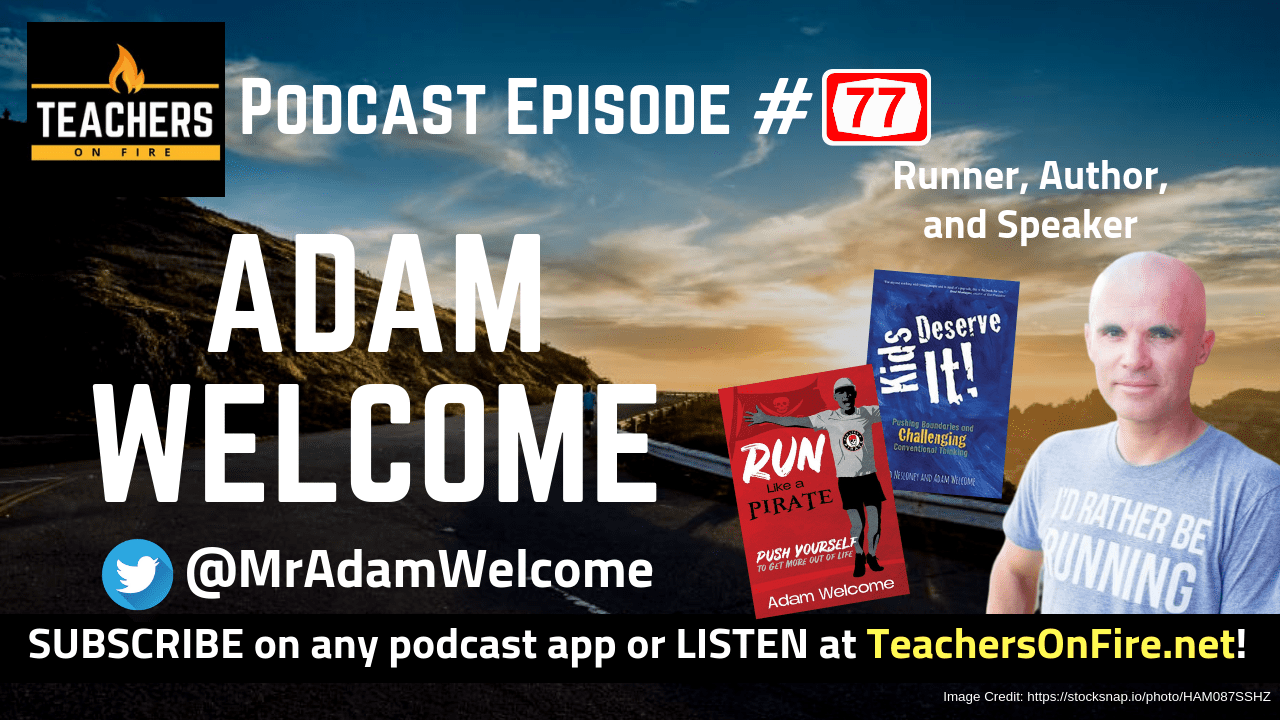
    ADAM WELCOME is a former teacher, principal, and director of innovation. He’s also a recognized education leader, speaker, and the author of Kids Deserve It and Run Like a Pirate. Follow Adam on Twitter and Instagram @MrAdamWelcome.

    Disappointed by Mediocrity

    Adam recalls the year that his professional enthusiasm was dampened by colleagues who preferred to stay with conventional practices and were reluctant to support new initiatives. Students were disengaged, there was little laughter in classrooms, and he knew learning was being sacrificed in exchange for convenience. It was frustrating to see.

    Finally, Adam decided to change grade levels and acquire his administration credentials. That move helped him get to a place where he could put his money where his mouth was and actually do the hard work of building school culture instead of complaining about negativity.

    When you’re in a tough situation, try to stay positive and actually do something about the problem, Adam urges. This too shall pass, and you can be that positive solution.

    The Birth of #KidsDeserveIt

    After connecting with Todd Nesloney on Twitter and then chatting with him further at a principals’ conference, Adam realized the two educators shared a passion for putting the welfare of students at the forefront of their work.

    After a tweet to that effect was widely shared, Adam and Todd wrote a blog post on the topic and then developed their ideas more fully in Kids Deserve It. #KidsDeserveIt continues in the form of book studies, Twitter chats, and an educational philosophy of school formation.

    13 Marathons in One Year

    Run Like a Pirate followed an impressive year of 13 marathons in 12 months. Although he was fairly public about his running goals and activities, Adam didn’t envision a book at the outset of the year. But after more and more people were inspired to set new fitness goals and do more with their lives, Adam started to think seriously about writing the book. Although he couldn’t do much writing during his year of marathons, the ideas and passion flowed quickly in the months that followed, and #RunLAP was born in the spring of 2018.

    More than just running, this is a book about realizing our full potential, about challenging our vision of what is possible. In some ways, #RunLAP is #ThePowerofYET (I’m not a runner … yet).

    When we put ourselves in a box by saying we’re just NOT something, it’s kind of demeaning. But when we take the opposite stance, when we say we can become anything we want to be, our students see that and build confidence as well.

    What Excites Adam About Education Today

    Adam appreciates innovations in education like edtech tools and the makerspace movement, but the macro change that really gets him excited is the idea of teachers backing up and taking more of a facilitation role in their classes.

    Doing so frees up time and energy for teachers to build relationships with students and conference more often on a 1:1 basis. It also empowers students to take more agency and ownership over their learning journey. Teachers are no longer chiefly sources of information – they’re coaches, facilitators, and enablers.

    Personal and Professional Goals

    In education, Adam is focused on doing more video content. The world is moving more and more to video, which gets more play, engagement, and excitement. It’s where our younger learners are moving for learning, and it only makes sense to develop our message on video platforms.

    As a personal goal, Adam looks forward to a 4-marathons-in-4-days event coming up in the Bay Area that uses 4 bridges to come up with the necessary miles. Being comfortable is easy, but nobody grows in the comfort zone. He’s looking for ways to push himself professionally and physically this year.

    Passions and Productivity Hacks

    Adam gains fuel from his family, and lately he’s also been inspired by leadership books outside of education. Authors like Jocko Willink, who’s written Extreme Ownership and also produces a podcast, are particularly inspiring.

    He’s also a big believer in strong starts to the day, including getting up early and making the bed. Although he’s given up trying to make his bed while his wife is still in it, his kids have learned to practice this habit from a very young age. It’s about starting the morning right and feeling fully prepared for the day.

    Voices & Resources That Inspire Adam’s Professional Practice

    On Twitter, Adam recommends following the wonderful @RaeHughart, guest on episode 73 of the Teachers on Fire podcast.

    One of Adam’s go-to edtech tools is Evernote. Whether you go with Evernote, OneNote, Google Keep, Wakelet, or another curation and note-taking tool, find and use one that syncs across all platforms and devices, he advises.

    Adam’s book pick is Extreme Ownership: How U.S. Navy SEALs Lead and Win, by Jocko Willink and Leif Babin. Although these authors come at leadership from a military perspective, the lessons and principles they share are universal and apply equally in education.

    Sticking with the same author in the world of podcasts, Adam recommends listening to the Jocko Podcast. He also loves The Rich Roll Podcast, produced by another vegan and legendary runner with a phenomenal personal story.

    Over on YouTube, Adam shouts out CJ Reynolds, an inspiring English teacher in Philadelphia who also appeared on Teachers on Fire at episode 39. His YouTube channel is called Real Rap with Reynolds.

    We sign off on this conversation, and Adam gives us the best ways to connect with him online. See below!

    See more from Adam:

    Subscribe to the Teachers on Fire podcast on your mobile device.

    iTunes | Google Podcasts | Spotify

    Follow the Teachers on Fire podcast on social media.

    Song Track Credits

    Listen on YouTube and subscribe to the Teachers on Fire channel.